Adjusting Your Home Yoga Corner as the Daylight Gets Shorter
Quick Answer: Most home yoga corners are placed for natural light, and when the light disappears the space stops feeling inviting — which is usually why autumn practice fades, not motivation. The fixes are specific: add warm, low-level lighting at floor and eye level rather than overhead, move the mat away from cold windows and drafts, and shift practice earlier or add a light source that signals ‘practice time’. A corner that works at 6pm in December has to be designed for artificial light from the start.
You practiced four times a week all summer without thinking about it. It’s late October, you’ve practiced twice this month, and you can’t identify what changed.
The honest answer is usually that the room got dark, cold, and slightly unwelcoming — and none of those things feel like a reason, so nobody addresses them.
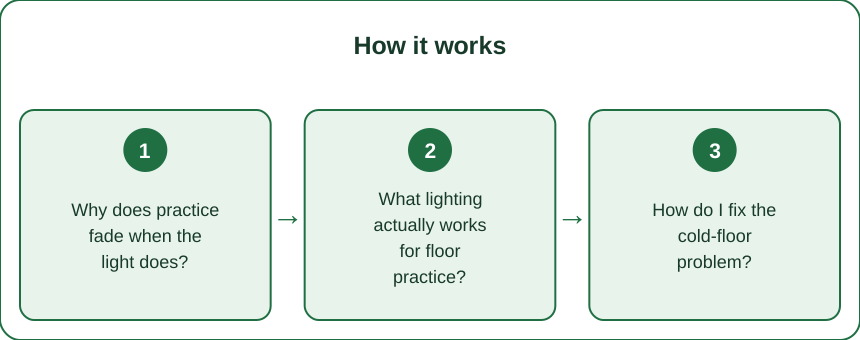
Why does practice fade when the light does?
Because the corner’s appeal was doing more work than you realized, and most of that appeal was light.
A sunlit corner is intrinsically inviting. You walk past it and want to be in it. The same corner under a ceiling fixture at 7pm reads as a bare patch of floor, and the pull disappears.
Overhead lighting is specifically bad for floor practice. It’s directly in your eyes in every supine pose, it flattens the space, and it casts shadows downward, which makes a floor-level activity feel like it’s happening in a poorly lit room — because it is.
Circadian factors are real too. Reduced light exposure shifts energy and mood, and evening practice competes with a stronger pull toward rest than it did in July. This is physiological, not a discipline failure.
And the room got colder. Floor level is the coldest part of any room, and a cold floor makes savasana genuinely unpleasant in a way that ends practices early.
The good news is that all four are fixable with things you probably already own, and the fix takes about twenty minutes.
What lighting actually works for floor practice?
Low, warm, and indirect — at least two sources, neither of them overhead.
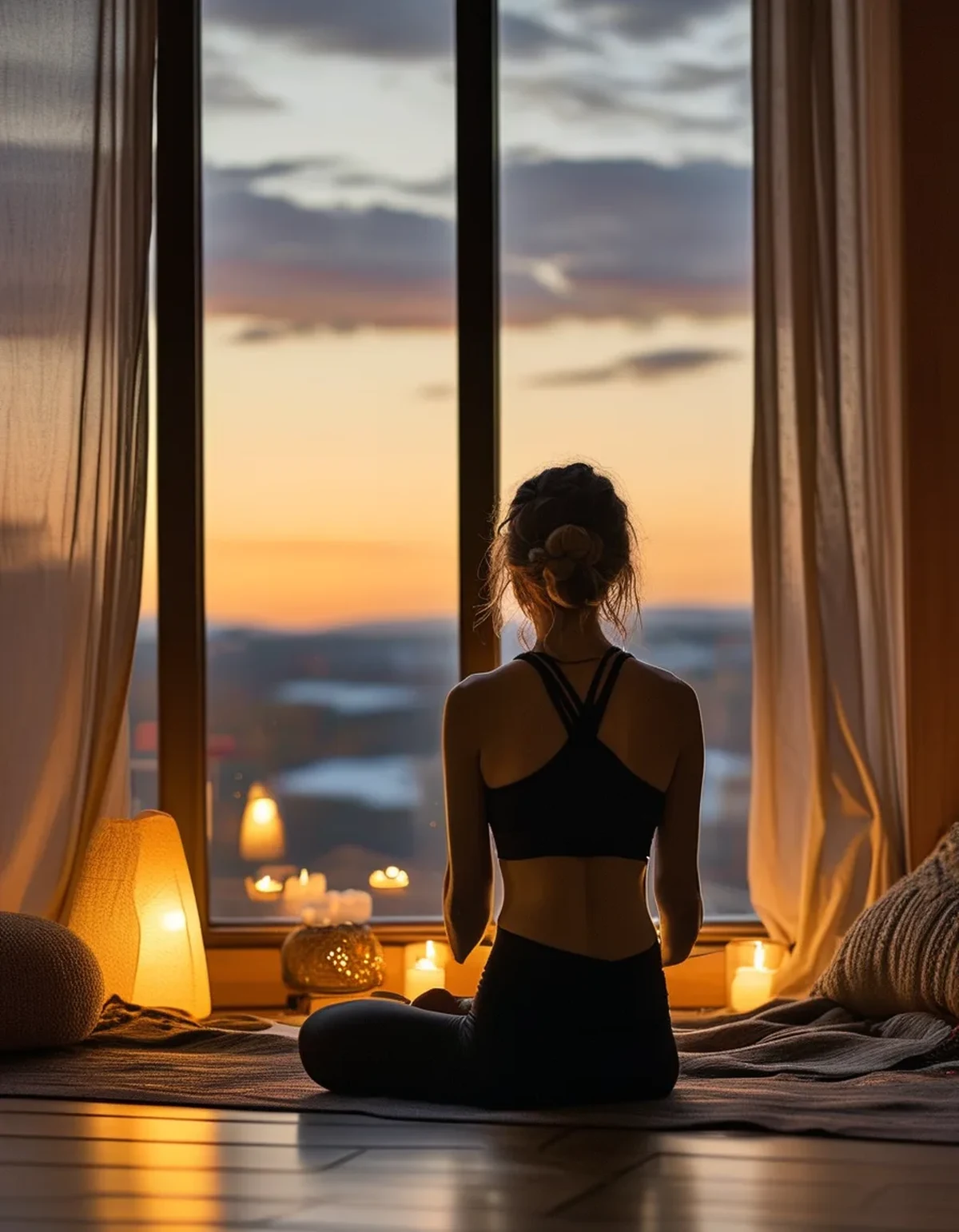
Put light at floor and eye level. A floor lamp beside the mat, a table lamp on a nearby surface, or a string of warm lights along the base of a wall. These light the space you’re actually in.
Warm color temperature, 2200 to 2700K. Cool white light suppresses the wind-down response and reads as functional rather than restful. This single specification changes how the corner feels more than any other choice.
Dimmable if possible. A brighter setting for standing sequences and a lower one for restorative and savasana turns one corner into two spaces, and the transition itself becomes part of the practice.
Never leave the overhead on during floor work. If it’s your only option, face away from it, or drape a light diffusing fabric over the fixture if it’s safe to do so — but a single inexpensive floor lamp solves it properly.
Candles work and carry an obvious caveat. They’re excellent for atmosphere and genuinely unsafe near flowing fabric and moving limbs. Battery-operated versions get most of the effect with none of the risk, particularly at floor level.
Add one light you turn on only for practice. This is the underrated part — a dedicated light becomes a cue, and the act of switching it on starts the practice before you’re on the mat.
How do I fix the cold-floor problem?
Insulate the mat from the floor and address the draft, in that order.
A rug or a folded blanket under the mat changes floor temperature perception substantially and costs nothing if you already own one. Cold conducts through a 5mm mat almost unimpeded.
A thicker mat or a second mat helps — many people practicing on hard floors in cold months double up, and it improves joint comfort at the same time.
Move away from the window. A mat placed for summer light is usually beside a window, which is the coldest surface in the room and the source of most drafts. Two feet of relocation often solves the entire problem.
Check for floor-level drafts specifically. Under doors, along skirting, and from vents. A draft excluder is inexpensive and the difference in savasana is immediate.
Have warm layers within arm’s reach. Socks, a sweatshirt, and a blanket for the final pose. Ending practice early because you got cold in savasana is common, and the fix costs nothing.
Pre-warm the space if you can. Ten minutes of heating before you start, on a timer if the room has one. The first five minutes of a practice determine whether the rest happens.
What Nobody Tells You About Seasonal Home Practice
The practice doesn’t need to be the same practice.
Autumn and winter home practice works better when it’s shorter and more restorative, and people who insist on maintaining a summer-length vinyasa flow through December mostly stop practicing entirely.
Twenty minutes four times a week beats sixty minutes once. In a dark cold room, the barrier to a sixty-minute practice is high and the barrier to twenty is low. Consistency is the thing that carries through the season.
Restorative and yin suit the season genuinely, not as a consolation. Longer holds, more props, more floor time, less standing. They’re also warmer to practice in a cold room, because they need less space and produce less cooling from sweat.
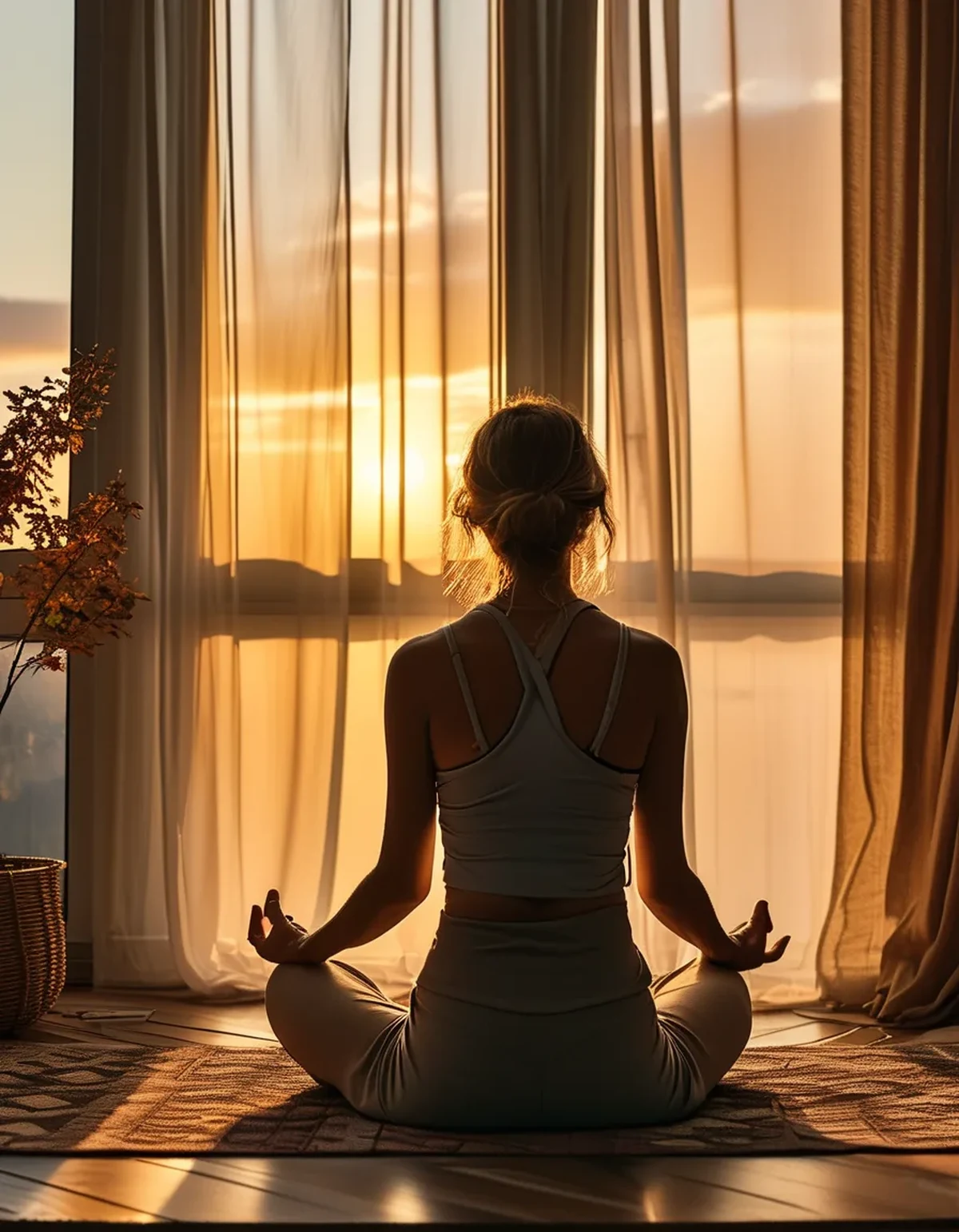
Morning practice is worth testing even if you’re not a morning person. Not for virtue — for light. A practice at 7am in December gets you dawn light and a room you’ll heat anyway for the day, and the evening version gets neither.
Nobody tells you that the corner may need to move. A summer corner and a winter corner can be different places in the same home. The winter one is warmer, further from windows, and nearer to whatever light source exists — and moving it is a reasonable, unremarkable adjustment rather than a failure of the original setup.
And the thing most people learn too late: the practices that survive the dark months are the ones with the fewest steps between deciding and starting. A mat that has to be retrieved from a closet is a mat that gets used half as often in November as it did in June, even though nothing about the mat changed.
How do I set the corner up so it survives the season?
Reduce the steps to zero, add two lights, and pick a specific time.
Leave the mat out. This is the highest-impact change and the one most resisted for tidiness reasons. A rolled mat in a cupboard adds a decision point, and decision points are where autumn practice dies. If it must be stored, store it leaning against the wall in the corner itself.
Props visible and within reach. Blocks, a strap, a bolster or firm cushion, and a blanket. Visible props prompt practice; stored props prevent it.
Two light sources, warm, one dedicated to practice. Covered above, and it’s the difference between a corner and a patch of floor.
Pick a time and attach it to something you already do. After dinner, before a specific show, immediately after work clothes come off. An anchor beats an intention.
Set a low bar explicitly. Ten minutes counts. The seasons where practice survives are the ones where the minimum was low enough to hit on a bad day.
Re-evaluate in four weeks. If the corner isn’t getting used, something specific is wrong — cold, dark, cluttered, or awkwardly placed — and it’s worth twenty minutes of diagnosis rather than another month of assuming it’s willpower.
FAQ: Seasonal Home Yoga Space Questions, Answered
What’s the ideal room temperature for home practice?
Around 68 to 72°F for general practice, and warmer for anything restorative where you’re still for long periods. Floor level runs several degrees cooler than where your thermostat measures, so the room may need to read warmer than you’d otherwise set it.
Do I need a special lamp?
No. Any lamp with a warm bulb at floor or table height works. If you’re buying, a dimmable floor lamp with a 2700K bulb is the single most useful piece of equipment for a winter yoga corner.
Should I use a SAD lamp during morning practice?
Some people find bright-light exposure in the morning genuinely helpful for winter mood and sleep timing, and pairing it with an existing morning routine is a reasonable way to be consistent about it. It’s a separate intervention from practice lighting — bright and cool for daytime alertness, warm and dim for evening wind-down.
My space is a shared living room. How do I make it work in winter?
Use the light as the boundary. Turning on the practice lamp and turning down the room lighting creates a temporary space without any furniture moving. A rug that defines the area does the same job visually.
Is it worth practicing in a cold room, or should I skip it?
A cool room is fine for active practice and poor for restorative. Warm up longer before deeper stretching, since cold tissue is less compliant and pushing range of motion in a cold room is where home practice injuries happen.
This is general information, not medical advice.
TL;DR: The practice didn’t fade. The corner stopped being inviting.
- The appeal of a sunlit corner was doing more work than you realized — when the light goes, so does the pull.
- Two warm light sources at floor and eye level, 2200 to 2700K. Never overhead during floor work.
- A dedicated practice light becomes a cue and starts the session before you’re on the mat.
- Insulate the mat with a rug or blanket and move it away from the window — the coldest surface in the room.
- Shorter and more restorative is the seasonally correct practice, not a lesser version of the summer one.
- Leave the mat out. A mat in a cupboard gets used half as often in November.
Move the lamp tonight. It’s a two-minute change and it’s the one that decides whether the corner gets used in December.
See It in Motion
Seen here: UPF 50+ Short Sleeve Rashguard Swim Shirt — shop it on bubblelime.com
Keep Reading
This article is for general informational and styling purposes only. Fit, sizing, and product availability may vary.