Why Your Home Practice Is Shorter Than Your Studio Practice
Quick Answer: A studio class supplies external structure — a fixed start, a decided sequence, a teacher’s pacing, and social commitment. At home, you supply all four yourself while also practising, which is cognitively expensive. Replacing those four functions, rather than trying harder, is what extends a home practice.
You happily do 75 minutes in a room full of strangers. At home you unroll the mat, do some sun salutations, and are folding it back up at eleven minutes.
Nothing is wrong with your discipline. Four specific supports were removed and nothing replaced them.
What is a studio actually providing?
Four things, and none of them are the poses.
A decided sequence. In class, you never choose what comes next. That choice is genuinely expensive: at home, every transition presents a decision, and decision-making pulls you out of the interoceptive state that practice depends on. The mental mode required to plan a practice is incompatible with the mental mode of doing one.
External pacing. A teacher holds poses longer than you would. Left to yourself, holds shorten — often dramatically — because the discomfort threshold arrives sooner without an external voice.
A committed time block. You paid, you travelled, and you cannot leave without visibly leaving. At home the exit is free and instantaneous.
Social presence. Practising alongside others raises effort and duration, reliably and measurably, without anyone intending it.
Take all four away and what remains is you, a mat, and unlimited freedom to stop — which is exactly the condition under which most practices stop at eleven minutes.
How do you replace the sequence and the pacing?
By removing the choice, in advance and permanently.
Have three fixed sequences you never change. A 15-minute, a 30-minute, and a 50-minute. Write them on a card and keep it with the mat. Choosing which one to do is a single decision at the start; everything after that is decided.
Repetition is not a compromise here. Practising the same sequence repeatedly is how you notice change, because a familiar sequence gives you a stable reference against which your body’s day-to-day variation becomes visible. Constant novelty makes that impossible.
For pacing, use breath counts rather than time. Five breaths per pose, eight in longer holds. Counting breath externalises the pacing decision and gives you something to return to instead of the question of whether you have done enough.
Or use audio. A recorded class, a podcast-style guided practice, or even a teacher’s playlist supplies pacing without requiring a studio. Many people find a 30-minute recorded practice they repeat weekly works better than a fresh video every time — the familiarity is the point.
Set a timer for the total, not for poses. Knowing there are 22 minutes left removes the recurring question of when to stop.
What should the space itself do?
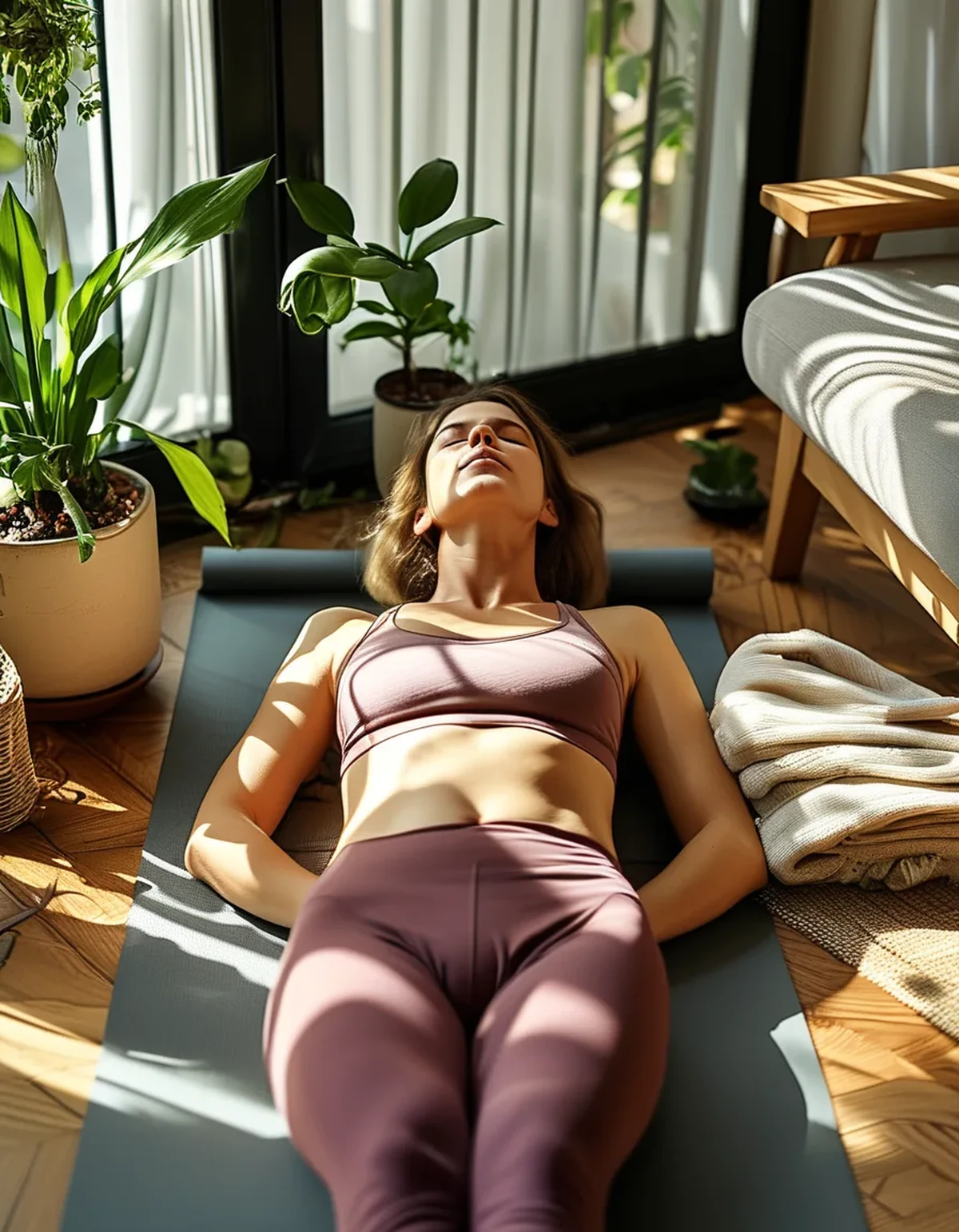
Remove friction and provide a signal.
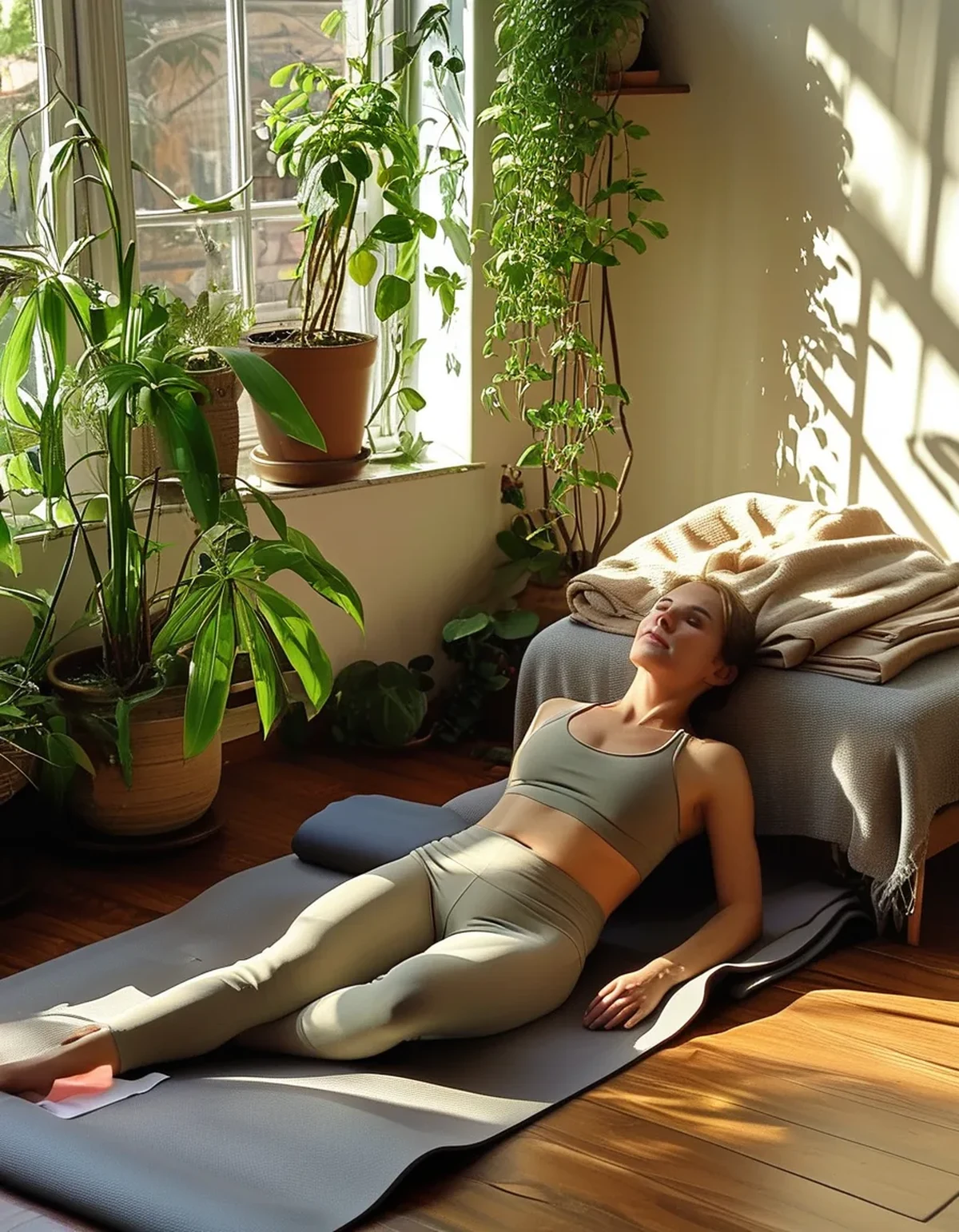
Leave the mat out. This is the single highest-impact change and it is free. Rolling out a mat is a two-minute task that becomes a decision point every time, and decision points are where practices go to die. A mat that is permanently down converts practice from an event into something you step onto.
Keep props within arm’s reach. A block, a strap, a folded blanket, a bolster or firm cushion. Getting up to fetch something mid-practice breaks the sequence and often ends it.
Define the boundary. The corner does not need to be a room, but it needs an edge — the mat itself, a rug, a specific patch of floor. Practising in a space that is also the walkway means competing with the space’s other functions.
Manage the visual field. Facing a wall or a window rather than a room full of undone tasks matters more than people expect. What is in your peripheral vision while you practise determines what your mind returns to.
Fix the floor temperature. Cold floors under bare feet and hands make long holds unpleasant, and they are a very common reason autumn practices get shorter. A rug under the mat solves it.
Myth vs Fact: home yoga practice
Myth: a short practice is not worth doing. Fact: fifteen minutes daily produces more change than ninety minutes weekly, for mobility, for nervous system regulation, and certainly for habit formation. The short-practice-is-pointless belief is the main reason people do nothing on busy days.
Myth: you need a dedicated room. Fact: you need a defined two-metre patch with the mat already down. Dedicated rooms are pleasant and are not the variable that determines whether you practise.
Myth: home practice should feel like class. Fact: it is a different activity with different strengths. Home practice is where you go slowly, repeat what you need, and stay in a pose for three minutes because you feel like it — none of which a class allows.
Myth: you should follow a new video each time to avoid getting bored. Fact: novelty is engaging and it prevents the familiarity that lets you notice progress. Most consistent home practitioners run a small number of sequences repeatedly.
Myth: if the practice keeps ending early, you lack discipline. Fact: it usually means there is no external pacing and no decided sequence. Add both and duration typically doubles without any additional willpower.
FAQ: Home Practice Questions, Answered
How long should a home practice be?
Whatever length you will repeat. Twenty to thirty minutes suits most people most days, with a longer session once a week if you want one. Setting a 60-minute standard and hitting it once a fortnight is worse than setting 20 and hitting it five times.
What time of day is best?
The time you will actually do it. Morning practice tends to be shorter and more mobility-focused because tissue is stiffer; evening practice tends to go deeper and helps wind-down. Both are legitimate — consistency of time matters more than which time.
Should I still go to classes if I practise at home?
If you can, yes. Classes provide correction, exposure to sequences you would not choose, and the social element. A common sustainable pattern is one class a week plus three or four short home sessions, with the class functioning as the input and home as the practice.
TL;DR:
- Studios supply a decided sequence, external pacing, a committed block, and social presence — home practice fails when none of those are replaced.
- Keep three fixed sequences you never change, and pace by breath count rather than by feel.
- Leave the mat permanently out, props within reach, and face a wall rather than the room.
- Fifteen minutes daily beats ninety once a week, comfortably.
You are not less disciplined at home. You are doing the teacher’s job and your own at the same time, and the fix is to do the teacher’s job once, in advance, on a card.
See It in Motion
Seen here: Racerback Tank Top - White — shop similar styles on bubblelime.com
Keep Reading
This article is for general informational and styling purposes only. Fit, sizing, and product availability may vary.