Home Yoga Lighting: Why Your Space Feels Wrong After Dark (and the Fix)
Quick Answer: Evening practice fails in most homes because the only light source is a bright overhead fixture - glaring straight into your eyes in every supine pose and flattening the room into task mode. The fix is three moves: kill the overhead entirely after dark, light the room from low and to the side with one or two warm sources (2700K or below, ideally dimmable), and place nothing bright inside your eyeline from the mat. As the days shorten from late August onward, this one change decides whether the evening practice survives the season.
Same corner, same mat, same playlist. In the morning the space practically breathes with you. At night you lie back for the first supine pose, stare into the ceiling fixture like a patient in a dental chair, and wonder where the calm went. It went the way of the daylight - and it comes back with a lamp.
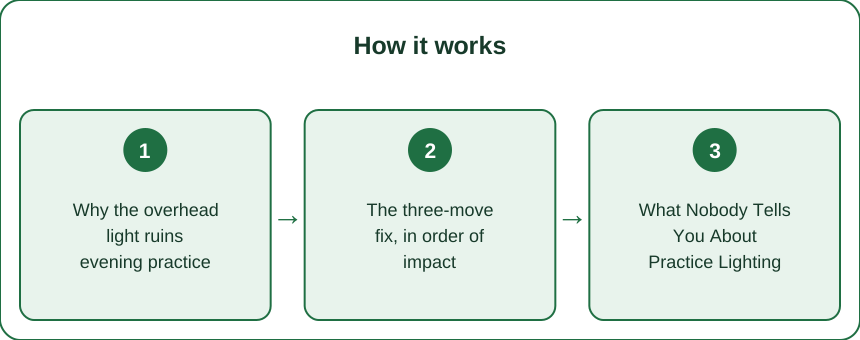
Why the overhead light ruins evening practice
The problem is anatomical, not aesthetic.
Yoga points your face at the ceiling constantly. Bridge, reclined twists, legs up the wall, savasana - a huge share of any practice is spent supine, eyes aimed exactly where homes mount their brightest fixture. No other room activity stares at the ceiling this much, which is why lighting that is fine for vacuuming is hostile for practicing. Glare directly in the visual field triggers squinting and a subtle facial tension that travels straight into the jaw and neck - the exact places the practice is trying to unclench.
Bright cool light is a wake-up instruction. Light in the blue-heavy range - most ceiling LEDs and any bulb labeled daylight - suppresses evening melatonin and signals alertness. An evening wind-down practice under 4000K downlight is sending the body two opposite instructions at once, and the light usually wins. This is the invisible reason evening home yoga can leave you oddly wired while the identical studio class leaves you soft.
Overhead light flattens the room into task mode. Interior lighting shapes behavior: even single-source ceiling light reads as work with kitchens and offices, low warm side light reads as evening and rest. Your brain has decades of that conditioning. Practicing under the same light you clean under keeps the nervous system filed in errand mode.
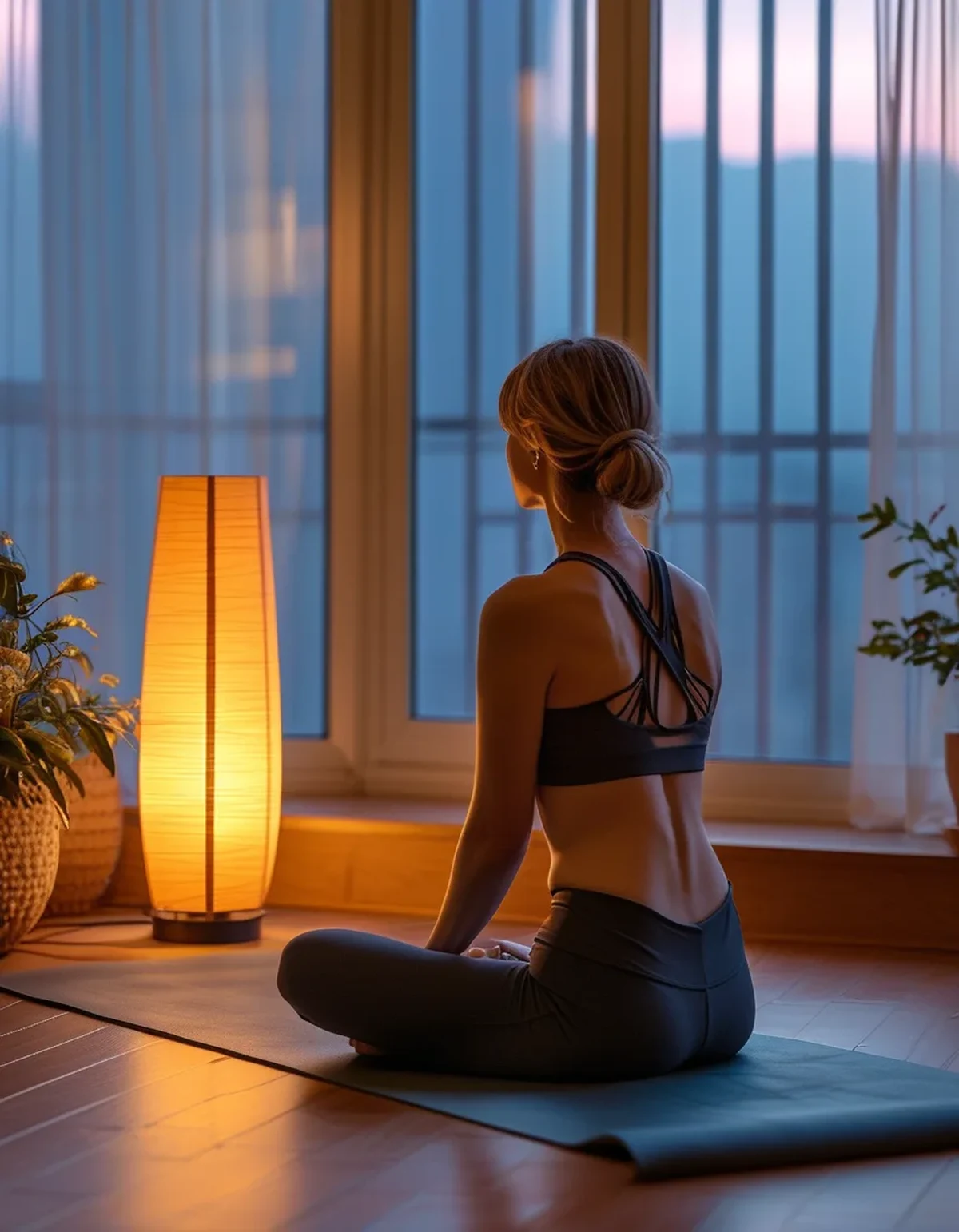
And daylight was doing more than you knew. The morning version of your corner is lit by soft, directional, warm-ish window light from the side - which is, not coincidentally, the exact recipe the evening fix recreates. You are not building something new after dark. You are rebuilding the morning.
The three-move fix, in order of impact
Move one: the overhead goes off and stays off. Not dimmed - off. This is the single highest-value change and it costs nothing. If the switch also controls your only light, that is the cue for move two.
Move two: one warm source, low and to the side. A floor or table lamp at roughly knee-to-shoulder height, positioned behind or beside the top third of your mat - never at the foot of it, where it sits in your eyeline through every forward fold. Bulb: warm white, 2700K or lower (the packaging says soft white or warm white; amber-toned filament styles are even better), modest brightness - think 400-800 lumens, the light of a pleasant reading corner. Dimmable is the upgrade worth three extra dollars: bright-ish for an energizing flow, near-candlelight for yin and savasana.
Move three: audit the eyeline from the mat itself. Lie down on your mat in the dark configuration and slowly look around the way a practice will make you look - up, both sides, behind you in a twist. Every bright point you can see directly (a bare bulb, the standby LED on the TV, the hallway light through the door crack) is a small tax on the practice. Shade the bulb, close the door, drop a sticker over the router light. Practitioners consistently underrate this step and are consistently startled by what it changes.
Optional fourth: a second, dimmer source for depth. A small lamp or a string of warm fairy lights across the room from the main source keeps the space from feeling like a spotlight in a cave. Two low warm sources at different heights is the entire lighting design of most expensive studios - and of most campfires, which is roughly the nervous-system register you are aiming for.
Total cost if starting from nothing: one lamp, one warm dimmable bulb, maybe a string of lights. Well under fifty dollars, and it outperforms every cushion and prop upgrade in the catalog for evening practice specifically.
What Nobody Tells You About Practice Lighting
Candles are wonderful and mostly a supervision problem. The flicker is genuinely calming - but open flame at floor level next to a moving body and drapey clothing earns its caution. Battery flame-effect candles have gotten shockingly good, cost little, and can sit inside the eyeline safely, which real candles never should. If you use real ones: on a stable surface above knee height, away from the mat’s reach, and snuffed before savasana drowsiness.
Warm light changes how balance feels. Dim environments genuinely challenge balance more - vision is a third of your stability system. Treat it as a feature with a dial: practice balancing poses in the brighter version of your setup, then let the dimness deepen only for floor work. If a dim evening flow feels wobblier than the same flow at noon, that is physics, not regression.
Screens sabotage the setup from inside. Following a class video means a bright cool rectangle inside your eyeline - the exact thing the room was just purged of. Fixes, in order: drop the screen brightness and enable the warm night-shift mode, place the screen low and slightly off-axis rather than at the head of the mat, or use audio-only classes for evening sessions and save video for daylight.
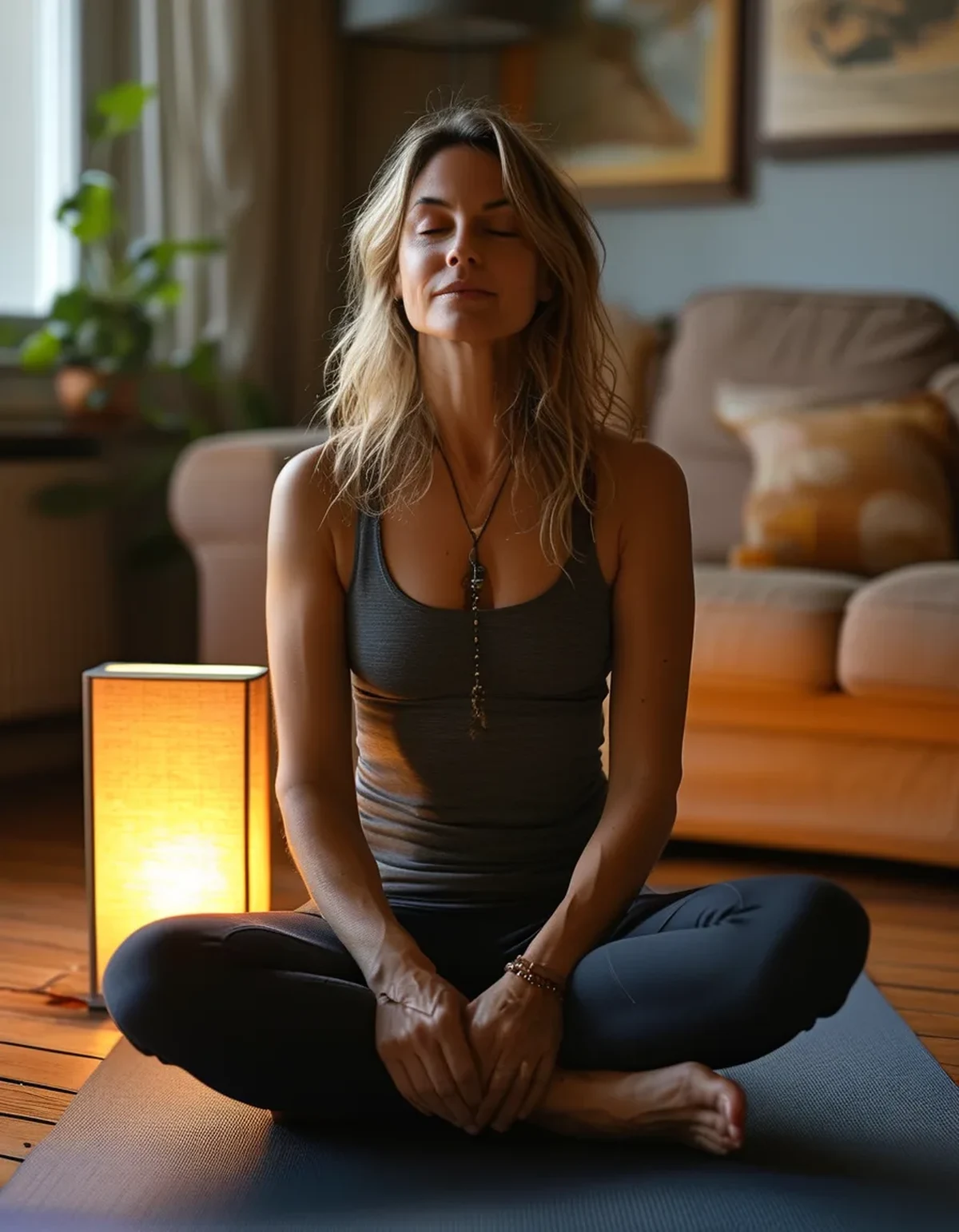
The lighting flip doubles as a start ritual. Off goes the overhead, on goes the lamp - and after a few weeks that two-switch sequence starts triggering the settle before you touch the mat. Behavioral cueing this cheap should be illegal. Same principle as changing into practice clothes: the body reads costume and set dressing. Leggings on, overhead off, lamp on - the practice has begun before the first breath.
And light spills over the mat’s edges. The same warm-corner configuration is quietly excellent for the reading, stretching, and journaling that happen near a yoga corner - which means the fifty-dollar fix upgrades the whole evening, not just the forty minutes on the mat.
Tuning the light to the practice - and the season
One setup, several settings.
Energizing evening flow: lamp at full, second source on. Enough light to see alignment clearly and keep balance honest - the setting for vinyasa after work, when the goal is movement first and wind-down second.
Slow practice and yin: main lamp dimmed low, second source off or barely on. Long holds do not need visual detail; they need the room to stop making demands. This is where dimmable earns its keep.
Savasana and yoga nidra: as close to darkness as comfort allows. A single amber glow at floor level across the room, or nothing. If total darkness makes the transition back awkward, the trick is dimming in stages through the final poses so savasana arrives at the bottom of a ramp rather than off a cliff.
Morning practice: ignore all of the above. Open the curtains, take the daylight, face the window if you can - bright morning light anchors the body clock and pairs with movement beautifully. The warm-and-dim doctrine is strictly an after-dark protocol.
The seasonal note that makes this urgent now: from late August, sunset moves earlier by a couple of minutes a day, and the 7pm practice that ran on daylight in June runs on your lighting choices by mid-September. Every year, a wave of home practices quietly die in the fall - not from lost motivation but from an unexamined room that got hostile at the exact hour the habit lived. Set the lamp up before the darkness arrives, and the habit never notices the season changing.
Renters’ addendum: every element here - lamp, bulb, string lights, a sticker over an LED - installs without a screwdriver and leaves with you. The serene corner is fully portable.
FAQ: Home Yoga Lighting, Answered
What is the best bulb for a yoga space?
Warm white at 2700K or below, dimmable, in the 400-800 lumen range, in a shaded lamp placed low and to the side of the mat. Amber filament-style LEDs are excellent for slow practice. Avoid anything labeled daylight or cool white for evening sessions - those belong to morning practice and the kitchen.
Can I just dim my ceiling light instead?
Dimming helps the brightness problem but not the geometry problem - the source still sits exactly where supine poses aim your eyes, and most ceiling LEDs dim into an unpleasant flicker or stay cool-toned. A cheap side lamp outperforms an expensive overhead dimmer for this specific room.
How do I follow video classes without wrecking the ambiance?
Lower the screen brightness, turn on the warm evening color mode, and set the device low and off to the side rather than at the head of the mat. For yin and wind-down sessions, audio-only classes preserve the room’s effect completely and are easier to follow in low light than people expect.
Is practicing in near-darkness safe?
For floor-based, familiar sequences, yes for most people - just keep a hand’s-worth of light for transitions. Keep standing balance work in the brighter setting, since dim light genuinely reduces stability, and keep pathways to the mat clear of props. Anyone with low vision or fall risk should keep the room comfortably lit throughout.
Does the lighting really matter more than props or a nicer mat?
For evening practice, usually yes - glare and cool light work directly against the nervous-system downshift that slow practice is for, while a firmer block mostly refines comfort. The fifty-dollar lighting fix changes whether the evening practice happens; gear changes how it feels once it does.
TL;DR:
- Supine poses aim your eyes at the ceiling fixture - the one light source evening yoga cannot tolerate. Turn it off entirely.
- Replace it with one warm (2700K or lower), dimmable, low side lamp behind the top of the mat, plus an optional second dim source for depth.
- Audit the room lying on the mat: shade or kill every bright point in the practice eyeline, screens included.
- Tune by practice - brighter for flows and balance, near-dark ramp for savasana - and leave mornings to daylight.
- Set it up in late August: shortening days kill more evening home practices than lost motivation ever does.
The corner was never wrong at night. It was just lit for chores - and calm, it turns out, is about forty dollars of lamp away.
See It in Motion
Seen here: Crewneck Short Sleeve Workout T-Shirt — shop it on bubblelime.com
Keep Reading
This article is for general informational and styling purposes only. Fit, sizing, and product availability may vary.