How Ceiling Height Quietly Limits Your Home Yoga Practice
Quick Answer: Home yoga guides talk about mat-sized floor space and stop there. But a huge share of standing sequences require your fingertips to clear the ceiling - and reaching overhead adds roughly 30 to 40cm above your standing height, before you get to anything inverted. In a room with a 2.3m ceiling, someone 1.7m tall has about 25cm of clearance overhead, which vanishes the moment they go up on their toes.
Measure the height as well as the floor, then adapt deliberately rather than discovering the limit mid-flow.
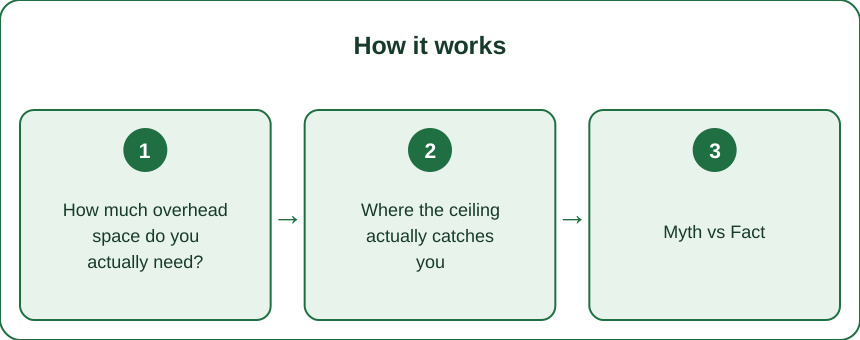
How much overhead space do you actually need?
The arithmetic is simple and almost nobody does it.
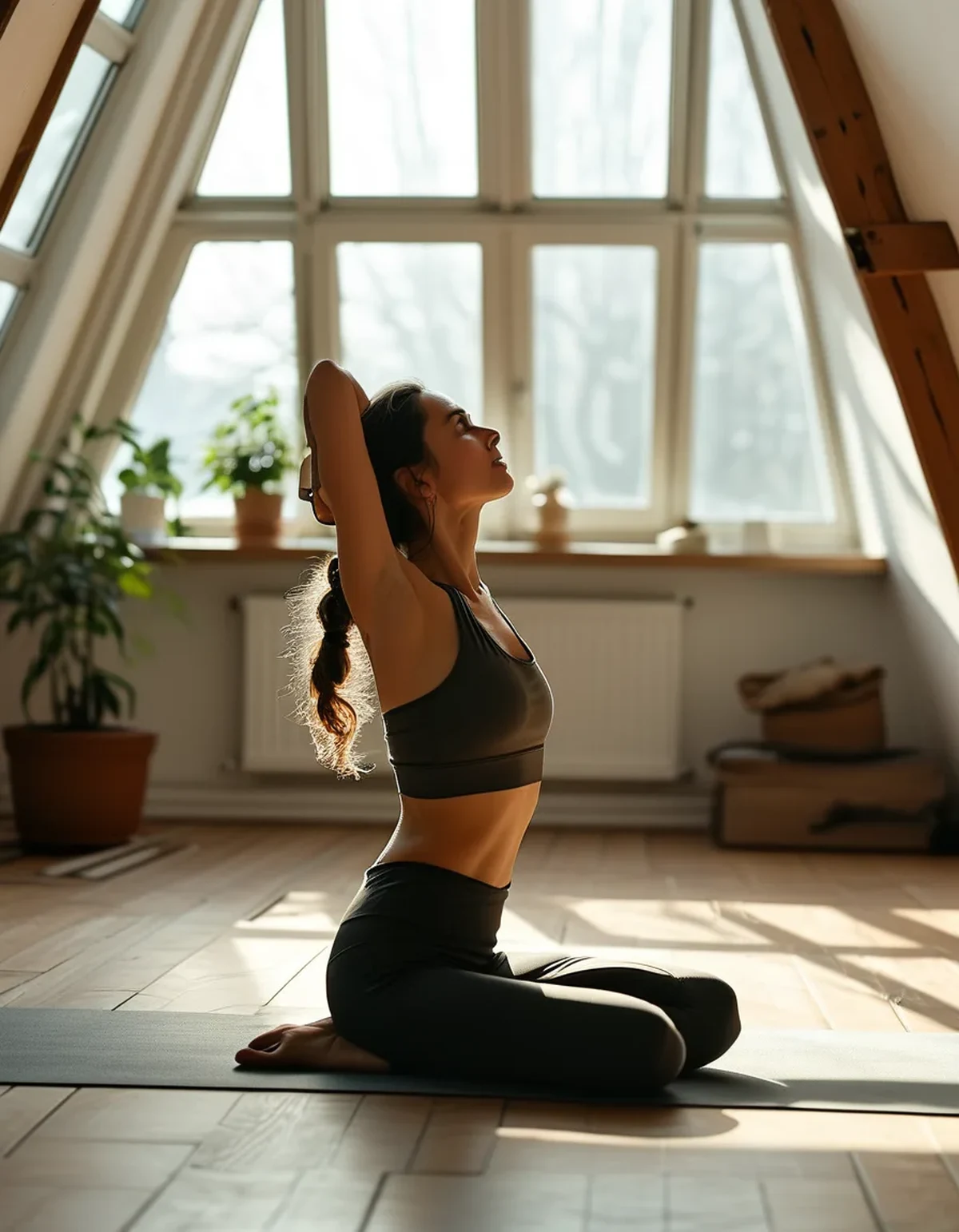
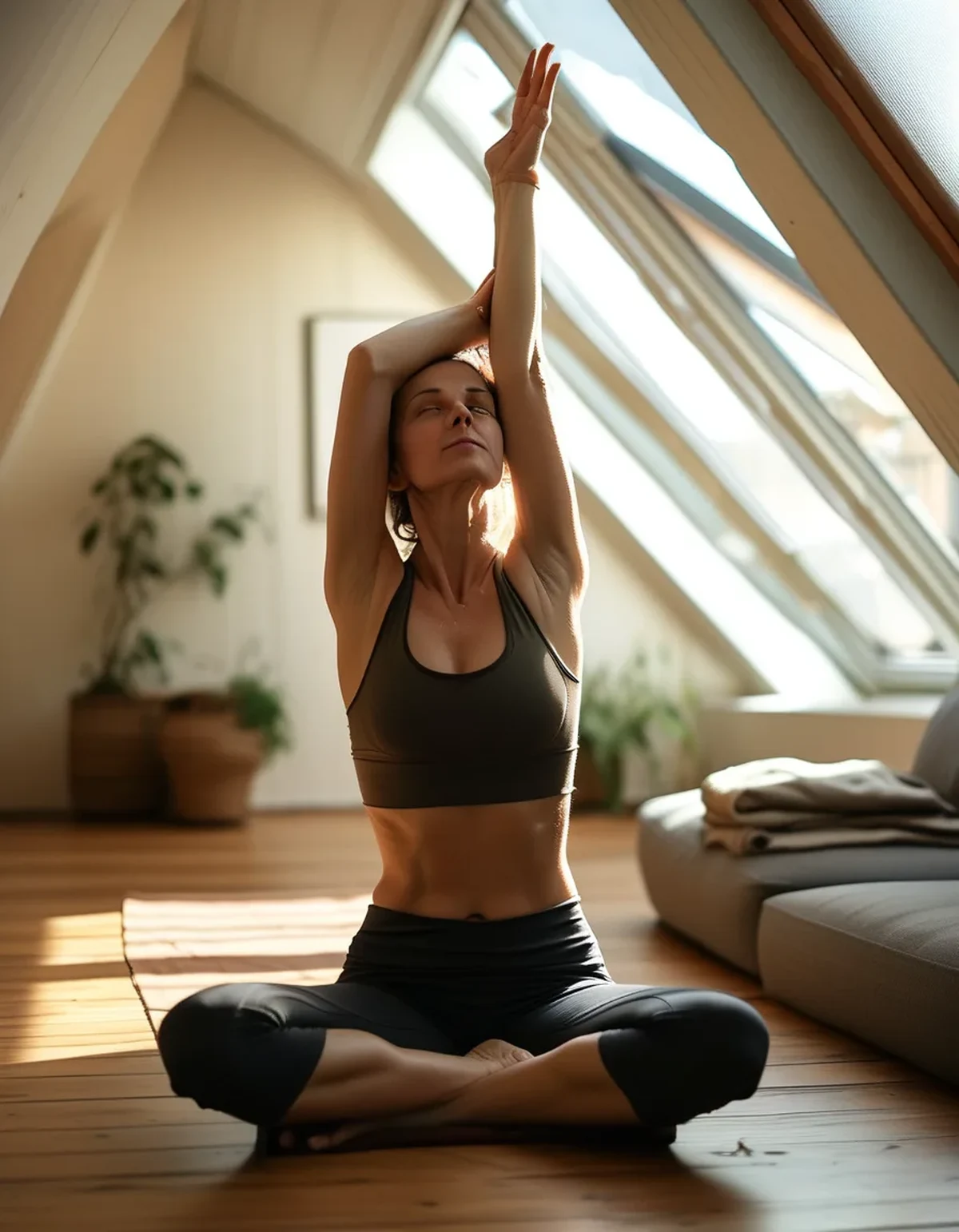
Standing with arms overhead adds roughly 30 to 40cm to your height - more if you have long arms, more again if you rise onto the balls of your feet as many sequences ask you to. So a person of 1.7m needs about 2.1m of clear height for a basic upward salute, and that is before adding the extra reach of a full extension.
Where the real problems start:
- Downward dog to standing transitions are fine, but the rise through to overhead reach is not
- Anything on tiptoes with arms up eats another 10cm instantly
- Standing balances with the arms overhead - tree, warrior one, eagle variations - all live in the top of the space
- Handstand or forearm balance against a wall needs your full height plus a margin, and the margin is not optional
Standard ceilings vary more than people expect. Older homes and modern flats often sit around 2.4m, basements and converted lofts frequently run lower, and sloped attic ceilings can be under 2m at the edges. The number that matters is the height directly above your mat, not the height at the highest point of the room.
Where the ceiling actually catches you
It is rarely a bang on the knuckles. It is a subtler kind of restriction that changes the practice without you deciding to change it.
Unconscious shortening. Once you have clipped a light fitting once, you stop fully extending overhead for months afterwards without noticing. The arms go up to 90 percent and stay there. Over time that becomes your normal range, and the shoulder mobility you were practising for quietly stops progressing.
Fixtures, not ceilings. The actual obstacle is almost never the ceiling itself - it is a pendant light, a smoke alarm, a ceiling fan, or a curtain rail. A ceiling fan over a yoga space is a genuine hazard, not a nuisance, and mat placement should treat it as a no-go zone rather than something to be careful about.
Sloped ceilings change with direction. In an attic room, your available height depends on which way the mat points. Rotating the mat 90 degrees can gain you 40cm of clearance and is the single easiest fix in a loft space.
The specific poses that suffer most in low rooms: upward salute and its variations, warrior one with arms overhead, extended side angle with the top arm reaching, and every inversion. The floor-based half of a practice - seated, supine, hip work, twists, restorative - is almost entirely unaffected, which is a useful thing to know when you are planning around a low room.
Myth vs Fact: Low Ceilings and Home Practice
Myth: A low ceiling means you cannot practise properly at home. Fact: It means one category of pose needs adapting. The majority of a typical practice happens below 1.5m and is entirely unaffected.
Myth: You can just angle your arms slightly. Fact: You can, and it is a reasonable adaptation, but the shoulder position in a full overhead reach is different from a diagonal reach - the diagonal version does less for shoulder flexion. Better to know you are substituting than to think you are doing the same thing.
Myth: Ceiling height only matters for inversions. Fact: Inversions are the obvious case, but the everyday cost is in standing sequences, which appear far more often in a general practice than any inversion does.
Myth: If it fits, it is fine. Fact: Clearance and comfort are different. If your fingertips are within about 15cm of the ceiling you will hold back, consciously or not, and the practice quietly narrows around the limitation.
What to do about it
Every fix here is cheap, and most take one afternoon.
Measure first, in the right place.
- Stand on your mat where you actually practise, reach fully overhead on the balls of your feet, and have someone measure the gap to the nearest obstruction
- Under 15cm of clearance means you should relocate or adapt. Between 15 and 40cm is workable with fixture management. Above 40cm and you can forget about it
Fixes in order of return:
- Rotate or move the mat. Free, instant, and usually enough in a sloped room. Practise facing the direction with the most headroom rather than the direction that looks nicest
- Change the light fitting. A flush ceiling light instead of a pendant can buy you 25 to 30cm, and it is the highest-return change in most low rooms
- Move away from the fan entirely. Do not negotiate with a ceiling fan
- Use a wall you can reach for supported inversions rather than trying to make the middle of the room work
Adaptations that keep the practice honest:
- Substitute a wall-supported version of the overhead reach so the shoulder still gets full flexion, just in a different orientation
- Do overhead mobility work seated or supine, on the floor, where the ceiling is irrelevant and the range is often better anyway
- Choose floor-heavy sequences for the low room and save standing-heavy flows for a class or an outdoor session
The framing that helps: you are not practising in a compromised space. You are practising in a space with a known constraint, and constraints are much easier to design around once they are named.
FAQ: Home Yoga Space Height Questions, Answered
What is the minimum ceiling height for a home yoga space?
For a standing practice without adaptation, aim for your height plus about 45cm - roughly 2.2m for someone of 1.7m. Below that you can still practise fully, but the standing overhead poses will need a substitute. There is no height at which floor-based practice becomes impossible.
Is a basement a bad choice for a yoga space?
Height is usually the constraint rather than anything else, and it is often lower than the rest of the house by exactly enough to matter. Check the height under any exposed ductwork or beams rather than in the clear middle of the room - that is where the mat will end up going.
Can I practise inversions in a low room at all?
Supported inversions against a wall - legs up the wall, supported shoulder work - are fine at almost any height and are the ones most people benefit from anyway. Free-standing inversions in a room where the ceiling is close is a genuinely bad idea, and this is one of the few places in home yoga where the answer is simply do it somewhere else.
TL;DR:
- Overhead reach adds 30 to 40cm above your standing height, more on the balls of your feet
- Under 15cm of clearance and you will unconsciously shorten every overhead reach
- Fixtures cause the problem more often than the ceiling - a flush light instead of a pendant buys 25 to 30cm
- Rotating the mat in a sloped room is free and often solves it completely
- Floor and seated practice is unaffected, so build the low room around what it does well
Measure upward once, with your arms up and on your toes. It takes thirty seconds and it explains a surprising amount about why the home practice felt slightly smaller than the studio one.
See It in Motion
Seen here: UPF 50+ Short Sleeve Rashguard Swim Shirt — shop it on bubblelime.com
Keep Reading
This article is for general informational and styling purposes only. Fit, sizing, and product availability may vary.