How to Share a Home Yoga Corner With Someone Who Works From Home
Quick Answer: The conflict is rarely about space - it is about noise, sightlines, and the feeling of being watched. Solving it usually means agreeing on time blocks rather than dividing territory, using a physical marker to signal the corner is in use, and moving to silent or headphone-based practice. Most shared-space yoga habits fail because nobody negotiated explicitly and both people quietly resented the situation.
The corner was perfect when the flat was empty during the day. Now there is a laptop, a video call, and a person twelve feet away who can see everything you are doing.

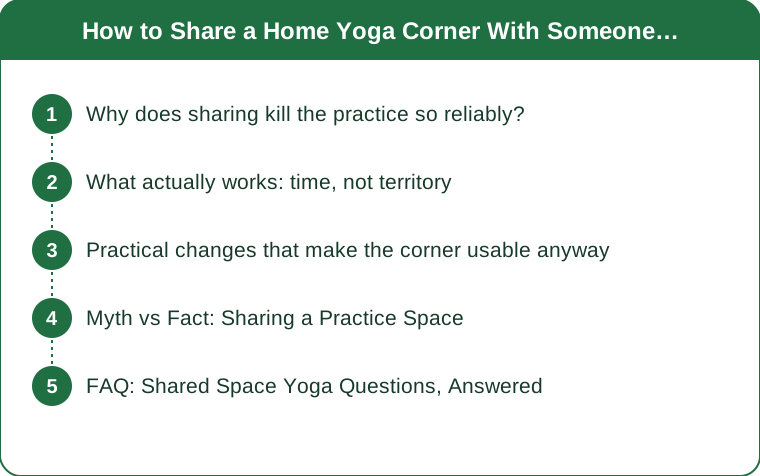
Why does sharing kill the practice so reliably?
Because it removes the specific conditions the habit depended on.
Being observed changes movement. Practising yoga in view of another person - even a familiar one who is not watching - introduces self-monitoring that most people find genuinely off-putting. Poses that feel unremarkable alone feel exposed with an audience, and the practice quietly shortens and then stops.
Uncertainty is worse than a firm no. If you do not know whether 11am is available, the decision has to be made fresh each day, and a decision that has to be made is a decision that eventually goes the other way. Habits survive on automaticity, and shared spaces destroy it.
Sound is bidirectional and both directions matter. You do not want a video call audible in your practice, and they do not want a yoga instructor’s voice audible in their meeting. Each person modifies behaviour to avoid disturbing the other, and both practices degrade.
The room stops being a yoga space and becomes a shared space with a mat in it. Environmental cues matter for habit formation - the corner worked partly because it signalled practice. Once it is also an office, the signal is diluted.
And there is a fairness dynamic underneath. Work has a legitimacy that personal practice often does not get granted, so the person practising tends to yield by default. That imbalance builds resentment slowly and is the actual reason many shared arrangements collapse.
What actually works: time, not territory
Almost every workable solution is scheduling rather than spatial.
Agree specific blocks in advance. Not “when the room is free” but “7-7.45am and 12.30-1pm are mine.” A named block removes the daily negotiation and gives your practice the same standing as a meeting.
Put it in the shared calendar if you both use one. This sounds excessive for a household and it is remarkably effective, because it makes the commitment visible in the same system that governs the other person’s day.
Use the natural gaps in a working day. Early morning before work starts, the lunch hour, and the end of the working day are usually uncontested. Trying to practise at 11am on a Tuesday is a fight over the busiest hour available.
Agree what happens when blocks collide. An unexpected call at 12.35 will happen. Deciding in advance whether you move or they take the call elsewhere prevents the tense improvisation that makes both people avoid the situation in future.
Be explicit about the tolerance for noise and movement, in both directions. Some people genuinely do not mind a yoga class audible in the background; others find it impossible. You cannot guess this and neither can they.
And revisit the arrangement. Working patterns change. An agreement made in one month is often obsolete two months later, and the failure mode is quietly abandoning it rather than renegotiating.

Practical changes that make the corner usable anyway
When time blocks are not enough, these reduce the friction.
Use headphones, always. This solves half the problem instantly and costs nothing. Wireless is worth it if you can - a cable across a mat during a flow is genuinely annoying.
Practise silently sometimes. A sequence you know well needs no audio at all, and silent practice is the single most compatible option with someone else working nearby.
Set up a visual signal. A rolled-out mat that stays out during your block, a screen, a plant moved into position - any physical marker that says “in use” reduces interruptions without anyone having to say anything.
Face away from the desk. Sightlines are most of the self-consciousness. Orienting the mat so your back is to the other person removes the feeling of performing without changing the room.
Consider a screen or curtain. A folding screen or a curtain on a tension rod costs little and creates genuine visual separation in a shared room. It is the highest-value physical intervention available.
Move to a smaller space if the shared one is contested. A mat-sized area in a bedroom is often better than a beautiful corner you can only use at unpredictable times. Habit consistency beats space quality more often than people expect.
And do not underestimate a door. If any room in the home has a door that closes, the practice that happens behind it will be more consistent than the practice that happens in an open shared area, regardless of which room is nicer.
Myth vs Fact: Sharing a Practice Space
Myth: You need a dedicated room for a consistent home practice. Fact: Consistency depends far more on a reliable time than on a reliable room. Plenty of long-standing home practices happen on a mat rolled out in a living room and put away afterwards. What kills practices is uncertainty about when, not compromise about where.
Myth: If they are wearing headphones, it does not matter what you do. Fact: Movement in peripheral vision is distracting during focused work even with sound removed, and being in someone’s peripheral vision is what makes practice feel exposed. Sightlines matter independently of noise, which is why facing away or using a screen helps so much.
Myth: You should just practise early so you never conflict. Fact: Early practice suits some people and is a reliable route to abandonment for others. The right answer is whichever slot you will actually use, negotiated as a block, rather than the slot that inconveniences nobody.
Myth: Asking for a dedicated time is unreasonable in a shared home. Fact: The alternative is an unspoken arrangement where one person’s needs always yield, which reliably breeds resentment. An explicit 45-minute block is a smaller ask than the ongoing tension it replaces.
Myth: It will sort itself out once you both get used to it. Fact: Unnegotiated arrangements tend to settle into whichever pattern is least confrontational, which is usually the practice being dropped. Things that sort themselves out do so in the direction of the path of least resistance.
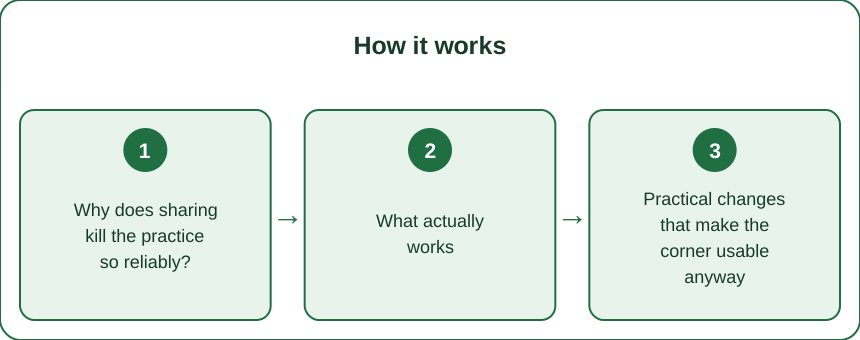
FAQ: Shared Space Yoga Questions, Answered
How do I practise yoga when someone is working in the same room?
Agree specific time blocks rather than using the room opportunistically, use headphones or practise silently, and orient your mat so you are not in their direct line of sight. Those three changes solve most shared-room conflicts.
Is it rude to do yoga while my partner is on a video call?
Movement in the background of a call is distracting for them and usually uncomfortable for you. This is the clearest case for a block-based agreement - knowing the call schedule in advance means neither person has to make an awkward request in the moment.
Should I move my practice to a different room?
If a smaller room with a door is available, it is often the better choice even if the space is worse. A consistently usable mat-sized area beats a beautiful corner with unpredictable availability.
How do I stop feeling self-conscious practising in front of someone?
Remove the sightline rather than trying to talk yourself out of the feeling - face away, use a screen or curtain, or practise when they are not in the room. Self-consciousness in view of others is common and not something willpower reliably fixes.
What if our schedules genuinely do not allow separate times?
Then negotiate for the slots that matter most rather than all of them - two protected 30-minute blocks a week is a workable practice, and it is far better than an unprotected daily intention that gets displaced every time.
TL;DR:
- The conflict is about sightlines, sound, and uncertainty - not about square footage.
- Named time blocks beat territory-sharing, and putting them in a shared calendar gives them real standing.
- Headphones and silent practice remove half the friction for free.
- Face away from the desk, or add a cheap screen - visual separation does more than any other physical change.
- A smaller room with a door beats a beautiful corner you can only use unpredictably.
The corner did not stop working. The agreement about when it is yours was never made, so it defaults to whoever needs it more loudly.
See It in Motion
Seen here: Racerback Tank Top - White — shop similar styles on bubblelime.com
Keep Reading
This article is for general informational and styling purposes only. Fit, sizing, and product availability may vary.