The Setup-Teardown Tax: Why Putting Your Yoga Space Away Kills the Habit
Quick Answer: Every step between deciding to practice and actually starting is a point where the decision can reverse. A mat that must be retrieved, a coffee table that must be moved, and props that live in a closet add up to about 90 seconds — which reads as trivial and functions as a filter. Practices that survive are almost always ones where the space stays set up, even if the space is small or imperfect.
You didn’t quit. You just kept not starting, on days when moving the coffee table felt like more than you had.
That’s not a discipline problem. It’s a design problem, and it’s fixable in an afternoon.
Why does 90 seconds of setup matter so much?
Because the setup isn’t competing with the practice — it’s competing with the decision to practice, and that decision is far more fragile than the practice itself.
The moment you decide to practice, you’re in a narrow window where intention hasn’t yet met friction. Every physical step in that window is a fresh opportunity to reconsider. Move the table, find the mat, clear the rug, get the block from the closet — that’s four chances to notice you’re tired, or that the kitchen needs doing.
This is why the barrier scales so badly. Two steps aren’t twice as hard as one; they’re a compounding series of exit points. And the effect gets worse exactly when you need the practice most — on low-energy days, when the friction that was trivial on Tuesday is decisive on Thursday.
There’s a second, less obvious cost. Setup requires you to imagine the whole session before you begin. Instead of I’ll roll out and see how I feel, it becomes do I want to do the full thing, including putting it all back? That reframing turns a low-commitment start into a high-commitment one, and low-commitment starts are what keep habits alive on bad days.
What does teardown cost you that setup doesn’t?
Teardown has its own distinct penalty, and it’s the one people underestimate.
It attaches an ending cost to the practice. A session that ends with fifteen minutes of savasana and then rolling everything away and returning props to a closet ends on a chore. Over weeks, the anticipated ending colors the decision to begin.
It punishes short sessions disproportionately. If setup and teardown together cost three minutes, a ten-minute practice carries a 30% overhead. That math makes short sessions feel not worth it — which is a disaster, because short sessions are what carry a practice through busy weeks. The overhead effectively sets a minimum session length, and on days you can’t meet that minimum, you do nothing.
It makes the practice invisible. A rolled-up mat in a closet provides no cue. A mat that stays out is a visual prompt every time you walk past it — and environmental cues are one of the more reliable drivers of habit formation. Putting it away doesn’t just cost effort; it removes the reminder.
Together, these explain a pattern that shows up constantly: practices that start strong, drift toward weekends only, then stop. Nothing changed about the person’s motivation. The overhead simply outlasted it.
What Nobody Tells You About Small Spaces
The advice for small apartments is usually to get a mat you can store easily and clear a space when you practice. That advice actively causes the problem.
Here’s the reframe: a permanently available small space beats a temporarily available large one, every time.
A 3x6 foot corner that’s always ready will get used more than a spacious living room that requires furniture to move. Most home practice doesn’t need much room — standing sequences, seated work, and floor work all fit within a mat’s footprint plus a little reach. The poses genuinely limited by space are a minority, and they can be adapted.
The specific moves that make this work:
- Find the smallest viable footprint — a mat plus about a foot on each side. Look behind a sofa, along a bedroom wall, or in the space at the foot of a bed.
- Accept an imperfect spot. The corner with slightly awkward light and a radiator nearby, permanently available, will out-serve the perfect spot you have to construct.
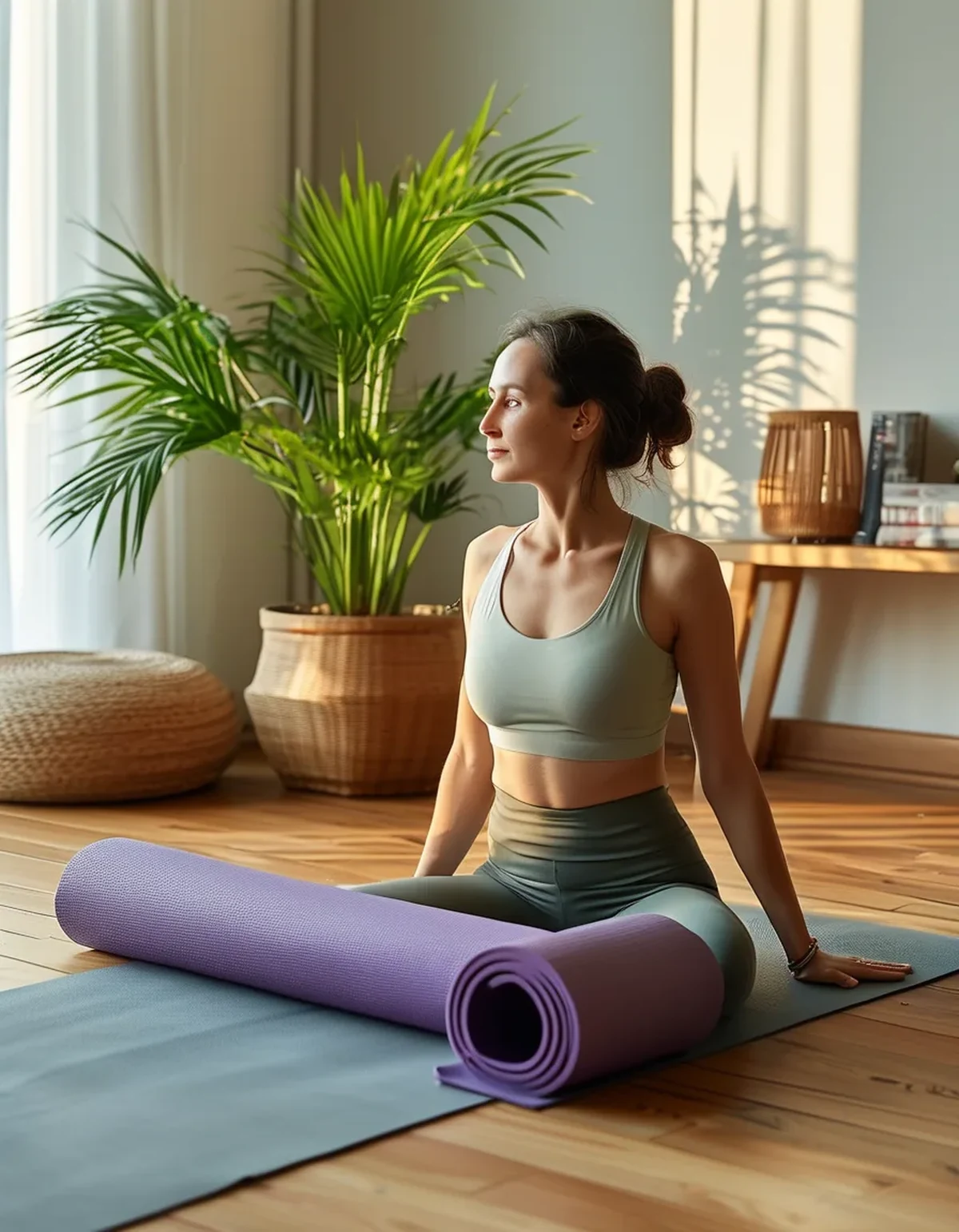
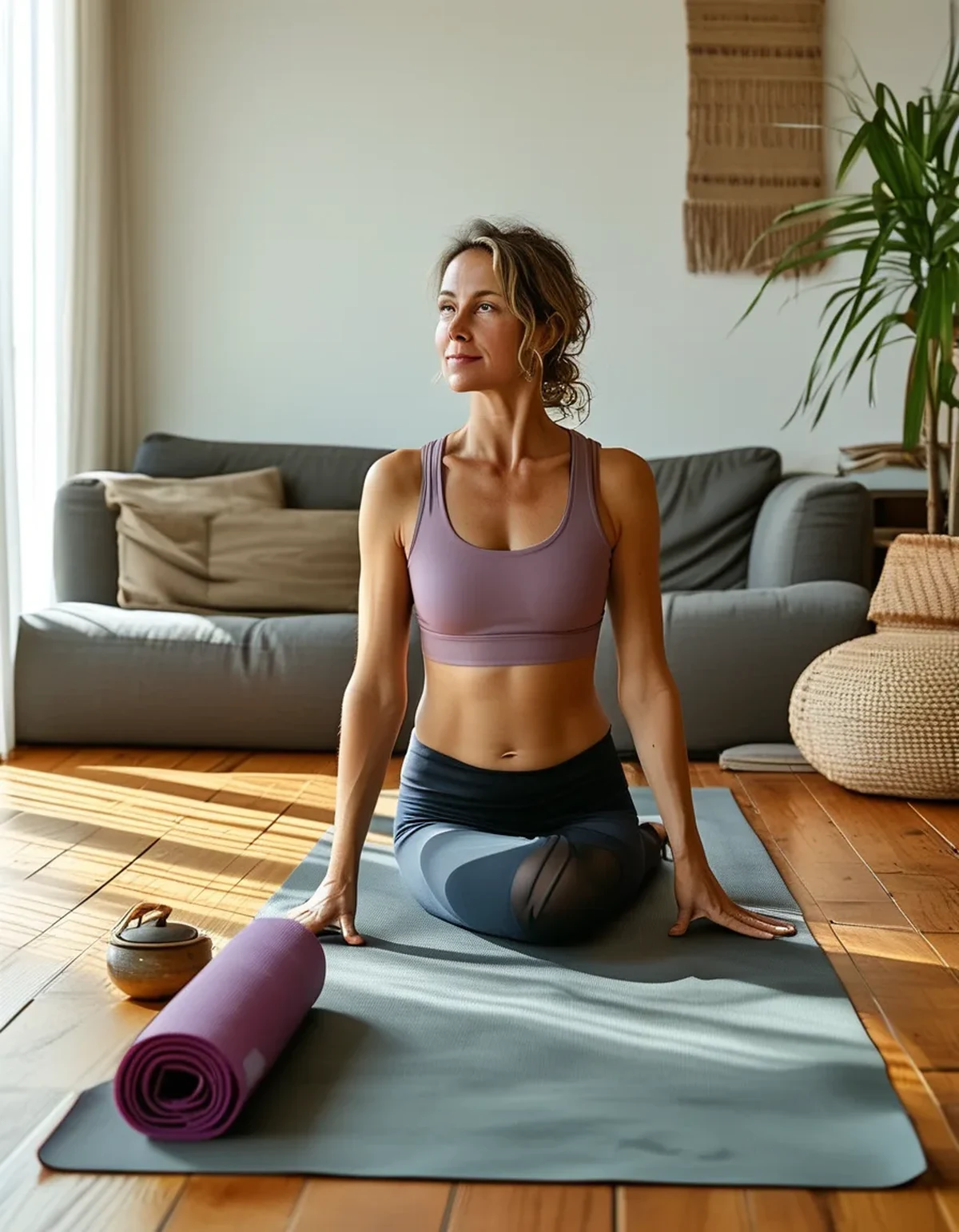
- Leave the mat down. This is the whole intervention. If a rolled mat in the corner is visually acceptable to you, that alone changes the frequency.
- Keep props within arm’s reach of the mat — a small basket beside it, not a closet down the hall.
If a permanent space genuinely isn’t possible, get the setup under 15 seconds: a mat leaning against the wall in the room where you practice, props in a basket next to it, nothing to move.
How do you actually set this up?
One afternoon, five decisions.
1. Choose the spot by availability, not quality. Walk your home and ask one question of each candidate: can this stay as it is? Rule out anywhere that requires furniture to move, anywhere in a walkway, and anywhere someone else needs during your usual practice time.
2. Leave the mat out. Flat if you have room, rolled and standing in the corner if you don’t. If a mat visible in your living room bothers you, choose one in a color that reads as part of the room — this is a real consideration, not a vanity one, because a space that irritates you gets reclaimed for storage within a month.
3. Put props in one container beside the mat. Two blocks, a strap, a blanket. One basket, arm’s reach. Not a closet, not another room.
4. Solve the light and sound once. A lamp you can reach from the mat, and whatever handles audio — a small speaker, or your phone in a fixed spot. Decide it now so it isn’t a decision each time.
5. Guard it against becoming storage. This is the failure mode for every home yoga corner. Flat empty floor attracts laundry baskets, packages, and bags. Leaving the mat unrolled helps, because a mat looks occupied in a way that bare floor doesn’t.
The test: from wherever you are, can you be on the mat in under 15 seconds? If not, something is still in the way.
FAQ: Home Yoga Space Questions, Answered
What if I share the space and can’t leave a mat out?
Negotiate for the smallest permanent footprint you can — even a mat standing rolled in a corner keeps the visual cue and cuts setup to seconds. If nothing can stay out, keep everything in one grab-and-go basket in the room itself, so it’s one trip rather than four.
Does the space need to look nice?
It needs to not bother you, which is a lower bar than nice. A corner you find slightly ugly still gets used; a corner that makes the room feel cluttered to you gets quietly disassembled within weeks. Choose accordingly.
What if my only option is a room I don’t like practicing in?
Use it anyway for a month and see. Preference for a space is largely built through use — most people who describe a favorite corner didn’t choose it for its qualities, they developed the association by practicing there repeatedly.
TL;DR:
- Setup and teardown compete with the decision to practice, and each step is an exit point.
- Teardown attaches a chore to the ending and makes short sessions feel not worth the overhead.
- A small permanent space beats a large temporary one — availability matters more than square footage.
- Leave the mat out, keep props in one basket beside it, and solve light and sound once.
- Target: on the mat in under 15 seconds from anywhere in your home.
Spend twenty minutes this weekend finding the spot that can stay as it is. It’s a smaller intervention than any of the motivation advice you’ve tried, and it works on the days motivation doesn’t.
See It in Motion
Seen here: Racerback Tank Top - White — shop similar styles on bubblelime.com
Keep Reading
This article is for general informational and styling purposes only. Fit, sizing, and product availability may vary.