What To Do When Your Home Yoga Corner Is in a Cold Room
Quick Answer: A cold room affects your practice in three specific ways, and only one of them is comfort. Muscle tissue at a lower temperature is genuinely less extensible, so your usual range of motion is not available for the first 10 to 15 minutes. Cold floors conduct heat out of your body far faster than cold air does, which is why a 17-degree room feels colder on a mat than standing up. And a cold room raises the activation energy required to start, which is the real reason practices stop. Warm the floor rather than the room, extend your warm-up, and heat the space for 15 minutes beforehand rather than continuously.
The corner works beautifully in September. By late October you stand in the doorway, feel the temperature, and decide to practice tomorrow.
That decision is not laziness. Three separate things are genuinely harder, and two of them are cheap to fix.

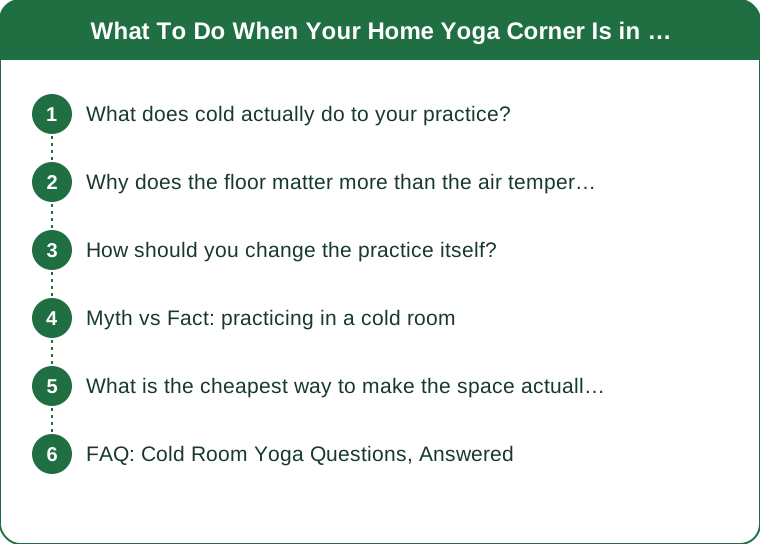
What does cold actually do to your practice?
Three effects, and they are distinct enough to need different solutions.
Tissue extensibility drops. Muscle and connective tissue are viscoelastic, meaning their resistance to stretch depends on temperature. At lower tissue temperatures they are stiffer and less compliant. This is not a feeling. Your available range of motion in a cold room genuinely is smaller for the first stretch of practice, by a meaningful margin in the larger muscle groups.
Conductive heat loss through the floor. This is the one people underestimate. Air is a poor conductor of heat. A hard floor is a good one. Lying supine on a thin mat over cold tile or concrete pulls heat out of you 20 to 25 times faster than the same temperature air does. This is why the room feels tolerable standing and unbearable in savasana.
Psychological activation cost. Cold raises the effort required to begin. It is a small barrier, but practice consistency is decided by small barriers, not large ones.
Why does the floor matter more than the air temperature?
Because contact conduction dwarfs convection, and most of your practice involves contact.
Standing poses have two small contact points. Floor work has your entire posterior surface pressed against the coldest thing in the room. A concrete basement slab or a tiled floor sits at or below the room’s air temperature and has enormous thermal mass, meaning it does not warm up from your body heat. It just keeps taking.
The practical implication is that insulating the floor beats heating the room, and it costs a fraction as much.
What works, roughly in order of effectiveness per dollar:
- A closed-cell foam mat or interlocking tiles under your yoga mat. Even 10mm makes a large difference. This is the single best purchase for a cold-room practice.
- A rug or thick blanket under the mat. Free if you own one, nearly as good.
- A folded blanket for floor sequences specifically. For savasana and supine work, lie on a blanket rather than directly on the mat.
- A thicker mat. Helps, but less than a separate insulating layer, because mat foam is chosen for grip and stability rather than for insulation.
A useful test: put your palm flat on the floor for 30 seconds. If it comes away cold, that is what your back is dealing with for the last 10 minutes of every practice.
How should you change the practice itself?
Extend the warm-up and re-order the sequence. Both of these are free.
Give yourself 10 to 15 minutes before expecting range of motion. In a warm room, 5 minutes of movement gets tissue temperature where it needs to be. In a cold room, it takes two to three times longer, and pushing into your usual depth before then is where cold-room strains happen.
Front-load standing and dynamic work. Sun salutations, standing sequences, anything that generates heat should come first and last longer than usual. Save floor work for the middle and end, when you have produced your own heat.
Shorten held stretches early and lengthen them late. A 90-second hold in minute 4 of a cold practice is not doing what a 90-second hold in minute 30 does.
Adjust your expectations for depth, explicitly. Your forward fold will be shorter. That is a temperature measurement, not a flexibility measurement, and it will return by minute 20. Practices go wrong when people interpret the cold-room version as a loss of progress and push to close the gap.
Reconsider savasana. The end of practice is when your metabolic heat production drops to nothing and you are motionless on the coldest surface in the room. Cover up. A blanket over you for the last 10 minutes is not indulgence, it is what makes the last 10 minutes survivable.

Myth vs Fact: practicing in a cold room
Myth: a cold room is dangerous to practice in. Fact: it is not dangerous if you extend the warm-up and respect the reduced range. The risk comes from doing a warm-room practice in a cold room, not from cold itself.
Myth: you should crank the heat for the whole session. Fact: 15 to 20 minutes of heating before you start, then off, is usually enough and far cheaper. Your own heat production during practice covers the rest, and most people end up too warm by minute 25 if the heater is still running.
Myth: cold means you should skip the warm-up and go straight to gentle stretching to save time. Fact: this is precisely backwards. Cold tissue needs more preparation, not less, and gentle static stretching does not raise tissue temperature the way movement does.
Myth: if you cannot reach your usual depth, you have lost flexibility. Fact: range of motion is temperature-dependent and recovers within a single session. Compare like with like, meaning minute 30 to minute 30, not minute 5 in October to minute 5 in July.
What is the cheapest way to make the space actually usable?
Roughly in order of what gives you the most for the least.
1. Insulate the floor. Foam tiles or a rug under the mat. Under 40 dollars usually, and it addresses the largest heat loss path.
2. A small heater on a timer, running 15 to 20 minutes before practice. A 1500W space heater will raise a small room by several degrees in that window. Put it on a smart plug or a mechanical timer so it starts before you get there. The barrier is walking into a cold room, so eliminating that specific moment matters more than the average temperature.
3. Dress for the first 15 minutes, not the last 30. Layers you remove as you warm. Socks with grip, which solve the coldest single contact point. A long-sleeve layer you shed after the standing sequence.
4. Close the gap under the door and cover the window at night. A cold room is often cold because of one specific leak. A draft excluder and a curtain can move a room several degrees for very little money.
5. Move the mat away from exterior walls and windows. Radiant heat loss to a cold surface is real, and you can feel the difference between a mat placed under a window and one placed two meters into the room.
Do this in September, not November. The pattern is completely predictable: the corner gets used less through October, people notice in late November, and by then two months of practice have quietly disappeared and the habit has to be rebuilt rather than maintained.
FAQ: Cold Room Yoga Questions, Answered
Is it bad to do yoga in a cold room?
Not inherently. Extend your warm-up to 10 to 15 minutes, expect less range early, and insulate the floor. The risk comes from doing a warm-room sequence at warm-room depth on cold tissue.
Why does the floor feel so much colder than the air?
Because a hard floor conducts heat away from you far faster than air does. That is why standing feels fine and savasana feels unbearable in the same room.
Should I heat the room for the whole practice?
Usually not. Fifteen to twenty minutes of heating before you start removes the barrier of walking into a cold room, and your own heat production covers the rest of the session.
TL;DR:
- Cold reduces tissue extensibility, so your usual range is not available for the first 10 to 15 minutes. That is temperature, not lost flexibility.
- The floor pulls heat out of you far faster than the air does. Insulate under the mat before heating the room.
- Front-load standing and dynamic work, save floor sequences for when you have generated your own heat, and cover up for savasana.
- Heat for 15 to 20 minutes on a timer before practice rather than continuously.
- Fix it in September. The corner does not get abandoned in one day, it gets abandoned over six weeks of small friction.
See It in Motion
Keep Reading
This article is for general informational and styling purposes only. Fit, sizing, and product availability may vary.