Why Home Practice Feels Shorter Than a Studio Class
Quick Answer: A studio class has built-in structure - arrival, warm-up, arc, peak, wind-down, savasana - and someone else holding the timing. At home you are running the class and attending it simultaneously, which fragments attention and compresses your sense of time. Home practice also skips the parts that make a class feel complete: the transitions, the holds, and the ending. Adding a fixed opening ritual, a written arc, and a non-negotiable 5-minute savasana closes most of the gap.
It is not that you lack discipline. It is that you removed the scaffolding and expected the building to stand.
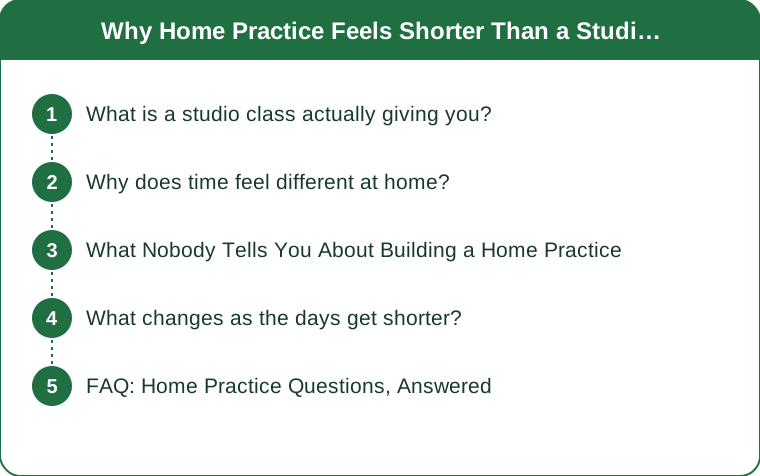
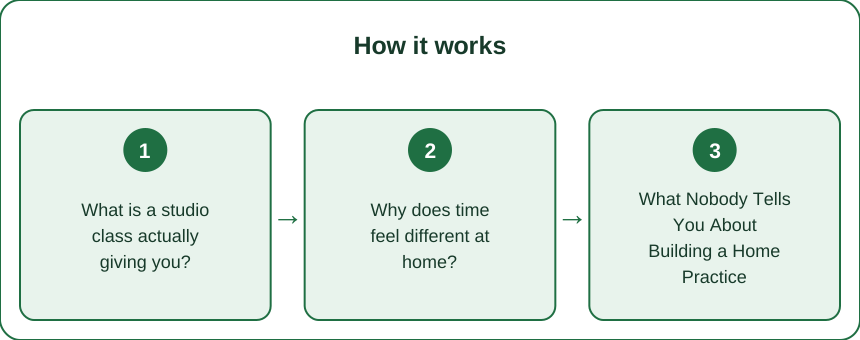
What is a studio class actually giving you?
Five things, and only one of them is the teaching.
A container with edges. The class starts and ends at fixed times, and you cannot leave early without a social cost. That boundary is what makes the middle feel like a complete thing rather than a stretch of time you might interrupt.
Someone else managing the arc. A well-built class has a shape - progressive warming, a peak, a descent. Building that shape while also doing it means your attention is split, and split attention makes time feel compressed and fragmented.
Enforced holds. Left to ourselves, most people leave a pose within a few breaths. A teacher holds you in a shape for eight breaths when you would have left after three. Those longer holds are a large part of why a class feels substantial.
Transitions taken deliberately. In class, moving between poses is guided and unhurried. At home, transitions collapse into rearranging yourself between the poses you were going to do anyway, which removes a surprising amount of both time and quality.
A proper ending. Savasana is the part most home practitioners skip, and it is the part that makes a practice feel finished. A practice without an ending feels like an interrupted practice, regardless of how long the middle was.
Why does time feel different at home?
Because attention and environment both change how duration is perceived.
Divided attention compresses time. Deciding what comes next while executing the current pose splits focus, and split focus produces fewer distinct memories of a period - which is exactly what the brain uses to estimate how long something lasted.
Familiar environments do not create new markers. A studio is a distinct place with its own sensory signature, and distinct settings create richer memories. Your living room floor generates fewer of those markers, so the same duration registers as less.
Interruption resets the clock. A phone glance, a delivery, a family member walking through - each one fragments the session. Even a two-second interruption breaks the continuity that makes time feel substantial.
No external timing means you rush. Without someone counting breaths, people move faster than they think. A sequence you believe took twenty minutes frequently took eleven - and this is worth testing with a timer once, because the result is usually surprising.
And the beginning is missing. In a studio, arrival, setting up, and settling take five to ten minutes and are part of the experience. At home you go from standing in the kitchen to downward dog in ninety seconds, which removes the transition your nervous system uses to signal that something different is starting.
What Nobody Tells You About Building a Home Practice
Shorter and structured beats longer and formless. A deliberate 20-minute practice with a clear arc feels more complete - and delivers more - than 40 unstructured minutes of moving between whatever occurs to you.
Writing the sequence down changes everything. A card or a note with eight to twelve poses in order removes the decision-making load entirely. You stop being the teacher and go back to being the student, which is most of the difference.
Time the holds rather than counting them. Set a timer for 45 or 60 seconds per side on key poses. Almost everyone holds shorter than they think, and holds are where the substance is.
The opening ritual matters more than the sequence. Rolling out the mat, closing the door, putting the phone in another room, three minutes of sitting - the ritual is what tells your nervous system that practice has started. Without it, the first ten minutes are spent arriving.
Repeat sequences rather than inventing them. The same sequence for two weeks builds familiarity, which lets attention move from what comes next to how it feels. This is how home practice becomes deeper than class rather than just more convenient.
Savasana is not optional, and five minutes is the floor. Setting a timer and lying down is the highest-value two-minute upgrade available. The practice you remember as complete is the one that ended properly.
And a fixed spot outperforms a better spot. A permanently available corner, even a mediocre one, gets used far more than a lovely space that requires clearing furniture first.
What changes as the days get shorter?
The seasonal turn quietly dismantles home practice, and it is worth pre-empting.
The daylight your practice was scheduled around disappears. Morning practices in a bright room become morning practices in a dark one, and evening practices lose the light entirely. The practice is not less appealing - the room is, and people rarely make that distinction.
Warm-ups need to be longer. Cooler rooms and stiffer mornings mean the first ten minutes of a home sequence should be gentler and more gradual than they were in August. Jumping into deep hip work in a 17°C room is how autumn strains happen.
Cold rooms shorten practices invisibly. A room that is a few degrees too cool produces a practice that quietly contracts - fewer holds, faster transitions, savasana skipped because lying still is unpleasant. A blanket and a small heater are practice-length interventions, not comfort ones.
Lighting is the highest-leverage fix. A warm lamp at floor level rather than a bright overhead changes how a dark-morning practice feels more than any sequence adjustment. This is the season to set that up.
And schedules shift with the season. Practices that lived in the early evening light often need to move to morning or later evening. Rescheduling deliberately beats letting the habit erode while you wait to feel like it again.
FAQ: Home Practice Questions, Answered
How long should a home practice be?
Twenty to thirty minutes with a clear structure works well for most people and is far more sustainable than aiming for an hour. Consistency at 20 minutes beats occasional 60-minute sessions comfortably.
Should I follow videos or practice on my own?
Videos provide the external structure and timing that make home practice feel complete, which is why they work so well early on. Self-guided practice develops a deeper relationship with your own body - the usual path is a mix, with videos for structure and self-guided sessions for exploration.
Why do I skip savasana at home?
Because nothing enforces it and the to-do list is visible. A timer and a commitment to lie down until it goes off solves it almost entirely, and it is the change most people notice fastest.
How do I stop getting interrupted?
A closed door, a phone in another room, and telling anyone else in the house the time you will be finished. Practicing at the edges of the day - before the household wakes or after it settles - removes most interruptions structurally rather than through willpower.
TL;DR:
- Studio classes supply structure, enforced holds, deliberate transitions, and a proper ending - home practice removes all four.
- Divided attention and a familiar room compress your sense of time, so a practice feels shorter than it was.
- Fixes: a fixed opening ritual, a written sequence you repeat for two weeks, timed holds, and a non-negotiable 5-minute savasana.
- As daylight shrinks, sort out lighting and warmth - both quietly shorten practices before motivation does.
None of this is about discipline. Studio classes work because someone built a container and handed it to you; at home, you have to build the container yourself, once, and then simply step into it - which is a much smaller job than trying to be motivated every morning.
See It in Motion
Seen here: High Waist Bootcut Yoga Pants with Pockets — shop it on bubblelime.com
Keep Reading
This article is for general informational and styling purposes only. Fit, sizing, and product availability may vary.