Why Your Home Practice Keeps Shrinking Without You Noticing
Quick Answer: Home practice shrinks because nothing external defines its endpoint. A class ends when the teacher says so; a home session ends when your attention wanders, which happens earlier each week as novelty fades. The fix is to give the session a fixed external container — a timed sequence, a set number of postures, or a recording — so the ending is decided before you start rather than in the moment.
Week one: forty minutes, full sequence, savasana.
Week six: you unroll the mat, do some cat-cow, check your phone, and roll it back up.
Nobody decided this. Here is the mechanism.

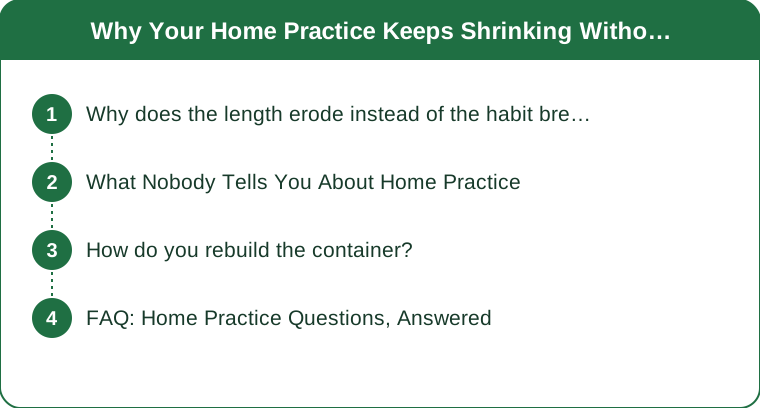
Why does the length erode instead of the habit breaking outright?
Because the habit of showing up and the habit of practising are two different things, and only one of them has a defined endpoint.
Showing up is anchored; finishing is not. You have a cue for starting — after coffee, before work, once the house is quiet. There is no equivalent cue for continuing, so the session runs until something interrupts it. Over time, the interruption threshold drops.
Novelty was doing the work early on. In the first weeks, the practice itself holds attention. As the sequence becomes familiar, it stops providing that pull, and nothing replaces it. This is why the erosion typically starts somewhere around week three to six rather than immediately.
Each shortened session resets the expectation. A twenty-minute session makes fifteen feel normal next time. There is no external reference point pulling it back up, so the drift is one-directional.
The decision happens mid-practice, when you are least equipped to make it. Deciding whether to continue while you are in a posture, slightly bored, with a phone nearby, is a decision made under exactly the conditions that favour stopping.
You do not notice because there is no record. Nobody times their home practice. The gap between the practice you believe you do and the practice you actually do widens invisibly, which is why this is usually discovered by accident.
What Nobody Tells You About Home Practice
A class is mostly a container, not mostly instruction. Experienced practitioners often assume the value of a class is the teaching. For most people, the larger share is the container — a fixed start, a fixed end, a room you cannot leave, and someone else deciding what comes next. Removing the container removes most of what made the practice happen, and no amount of knowing the postures replaces it.
The mat being out is worth more than any other single factor. The rolling and unrolling is a small friction that reliably decides sessions. A mat permanently in place converts a decision into a default.
Short and consistent genuinely beats long and sporadic, but only if short is chosen deliberately. A planned fifteen-minute practice is a completely different thing from a forty-minute practice that collapsed into fifteen — the first builds confidence, the second erodes it.
Your phone is the single largest cause of shortened sessions. Not because of willpower, but because a phone in the room provides an escape route at every moment of mild discomfort or boredom, and yoga generates plenty of both by design.
The room stops feeling like a practice space as its other uses accumulate. A corner that also has laundry, a laptop and a delivery box in it makes the practice compete with everything else in view. This tends to happen gradually, exactly like the shrinking sessions, and for the same reason: nobody is deciding it.
Autumn is when this hits hardest and when it is easiest to fix. Later sunrises mean morning practice happens in the dark, which changes how a space feels considerably. People who set up their corner in bright summer light frequently find it stops working in October without understanding why. A lamp positioned for practice, decided now, prevents a season of erosion.
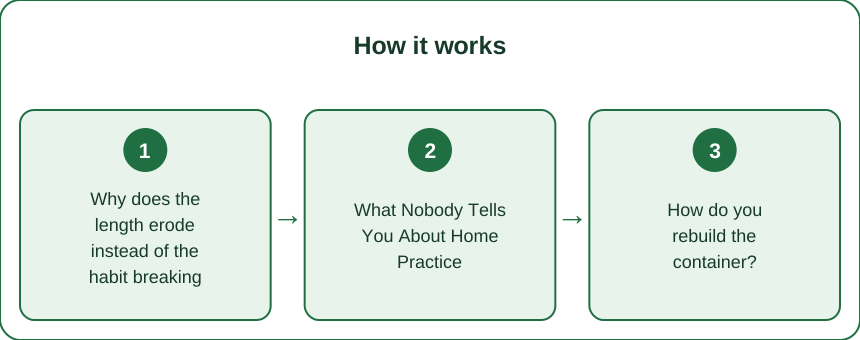
How do you rebuild the container?
Four options, in order of how reliably they work.
1. Use a recording. A video or audio class restores the external container completely — fixed length, decided sequence, someone else determining the end. This is the highest-reliability option and the one experienced practitioners resist most, often on the grounds that they should not need it. Reliability beats principle.
2. Set a timer and treat it as non-negotiable. Decide the length before you unroll the mat, set the timer, and do not stop before it sounds. Even a short timer works, because the point is that the ending is external.
3. Fix the sequence in advance. Write down a specific series of postures on a card and keep it with the mat. The session ends when the card ends, not when your attention does. This also removes the mid-practice decision-making that quietly drains the session.
4. Anchor it to something that ends on its own. A track of music of a known length, the time it takes for tea to steep and cool, a kettle, a candle burning down to a mark. Anything with an external endpoint you did not choose in the moment.
Keep the phone in another room. This is not a discipline recommendation, it is a design one. Use a separate timer or a smart speaker so the phone never needs to be within reach.
Track two numbers for a fortnight: date and minutes. Nothing else. The act of recording arrests the drift almost immediately, because the erosion depends on being invisible.
Rotate the sequence roughly monthly. Enough novelty to hold attention, not so much that you spend every session deciding what to do.
FAQ: Home Practice Questions, Answered
Is a short practice still worth doing?
Yes, provided it is a chosen length rather than a collapsed one. Fifteen deliberate minutes daily produces more than an hour on the weekend.
Should I follow videos or practise on my own?
Whatever gets you practising consistently. Self-led practice is a genuine skill, but it needs a container to stand in for the teacher — a timer, a written sequence, or both.
How do I stop checking my phone mid-practice?
Remove it from the room. Behaviour change built on resisting a temptation in the room fails; removing the temptation does not require any willpower.
Why do I practise less when it gets dark earlier?
Because the space genuinely feels different, and morning practice in the dark requires a lamp you probably have not set up yet. Fix the lighting before the clocks change.
What if I get bored halfway through every time?
That is normal and it is partly the point. A fixed sequence means boredom no longer gets to end the session — it just gets noticed and passed through, which is a large part of what the practice trains.
How long should a home practice be?
Whatever length you will do four or five times a week. Choose it deliberately, then protect it. The number matters far less than whether it was decided in advance.
TL;DR:
- Home practice shrinks because nothing external ends it — the decision happens mid-session, when stopping is easiest.
- Novelty carries the first few weeks. When it fades, nothing replaces it unless you build a container.
- Use a recording, a timer, or a written sequence so the endpoint is decided before you unroll the mat.
- Keep the mat out and the phone in another room. Both are design fixes, not discipline ones.
- Log date and minutes for two weeks — the drift depends on being unmeasured.
Sort the lighting now, before dark mornings do the deciding for you.
See It in Motion
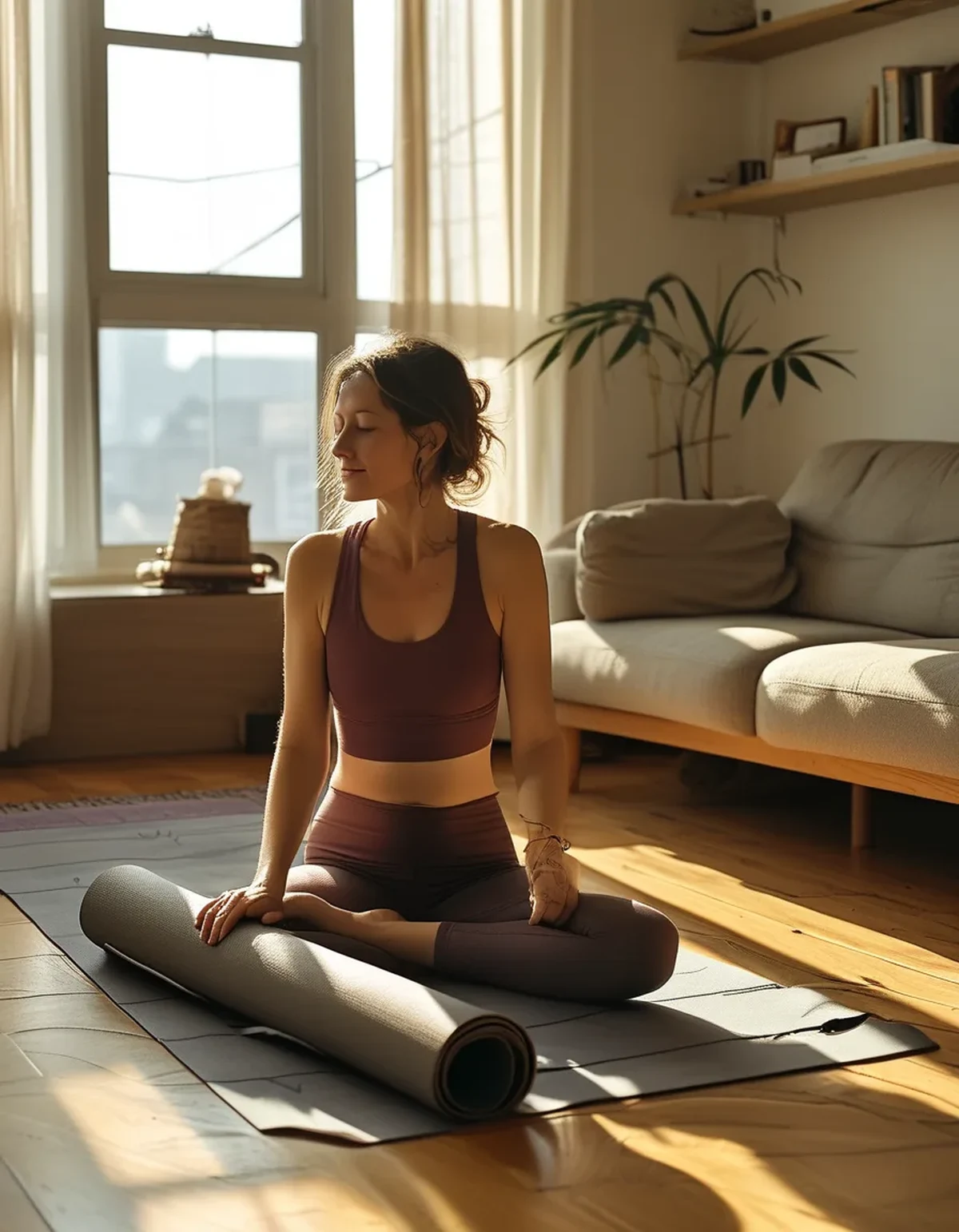
Seen here: High Waist Bootcut Yoga Pants with Side Pockets — shop it on bubblelime.com
Keep Reading
This article is for general informational and styling purposes only. Fit, sizing, and product availability may vary.